
Identifying the Problem
Before you start taking things apart, identify exactly what is not working. Is the fan completely dead? Is it making a humming noise but not spinning? Is the light working but not the fan? Or is it running but not actually pulling any air?
| Symptom | Likely Cause |
|---|---|
| Completely dead (no fan, no light) | Power supply issue, blown fuse, or bad control board |
| Light works, fan is dead | Bad fan switch or burned-out fan motor |
| Fan hums but doesn’t spin | Jammed fan blade or seized motor bearings |
| Fan runs but doesn’t pull air | Clogged grease filter or blocked ductwork |
Safety First
Before attempting any repairs on your range hood, turn off the power. Do not just turn off the switch on the hood; go to your home’s electrical panel and turn off the circuit breaker that supplies power to the kitchen exhaust fan.
1. Check the Power Supply
If neither the fan nor the light is working, the unit may not be receiving power.
- Check the breaker: Ensure the circuit breaker hasn’t tripped.
- Check the outlet: If your range hood plugs into an outlet inside the cabinet above it, plug a small lamp or radio into that outlet to verify it has power. If it’s hardwired, you will need a non-contact voltage tester to verify power at the wires (only do this if you are comfortable working with electricity).
2. Clean or Replace the Grease Filter
If the fan is running loudly but not pulling any smoke or steam, the most likely culprit is a severely clogged grease filter. Over time, the metal mesh filter traps grease and dust, eventually blocking airflow completely.
The Fix: Remove the metal filter (usually by pushing a small latch or sliding it out). Soak it in a sink filled with very hot water, a generous squirt of dish soap, and half a cup of baking soda for 15-30 minutes. Scrub gently with a non-abrasive brush, rinse thoroughly, and let it dry completely before reinstalling. If the filter is damaged or cannot be cleaned, replace it.
3. Inspect the Fan Blade (Impeller)
If the motor hums but the fan doesn’t spin, the fan blade (impeller) may be jammed with grease or debris.
The Fix: With the power off, remove the grease filter to access the fan blade. Try to spin the blade by hand. It should spin freely. If it is stiff or stuck, clean the area around the blade shaft with a degreaser. If the blade is broken or warped, it will need to be replaced.
4. Test the Fan Switch
If the light works but the fan does not (and the blade spins freely by hand), the fan switch may be defective. Switches wear out over time from repeated use and exposure to grease and heat.
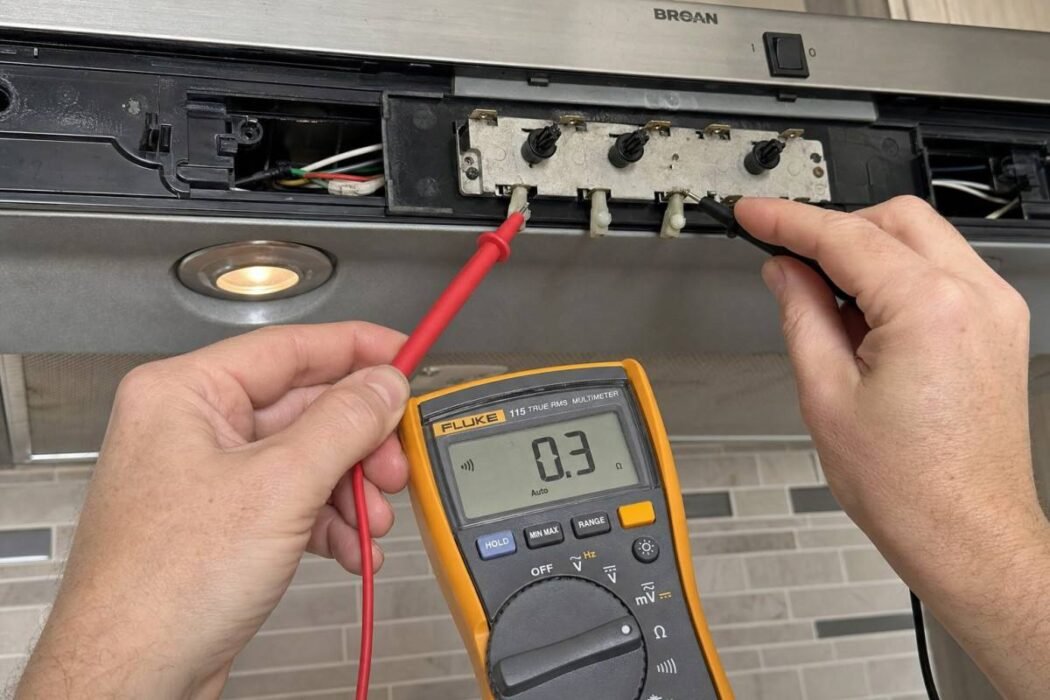
The Fix: Accessing the switch usually involves removing the control panel cover. You can test the switch for continuity using a multimeter. If the switch has no continuity when turned to the “on” position, it must be replaced. Ensure you order the exact replacement part for your specific range hood model.
5. The Fan Motor
If the switch is good, the blade spins freely, and the unit has power, but the fan still won’t run (or if the motor bearings are seized and won’t let the blade spin), the fan motor itself has likely failed.
The Fix: Replacing a fan motor is a more involved DIY project, but it is entirely possible. You will need to unplug the motor wire harness, unscrew the motor mounting bracket, and drop the motor out. Replacement motors are generally affordable and available online from appliance parts retailers.
Frequently Asked Questions
How often should I clean my range hood filter?
If you cook daily, you should clean the grease filter once a month. If you fry foods frequently, you may need to clean it every two weeks.
Why is my exhaust fan dripping grease?
A dripping exhaust fan is a clear sign that the grease filter is completely saturated and can no longer trap grease. The excess grease is pooling in the fan housing and dripping back down. Clean the filter immediately and wipe down the inside of the hood with a degreaser.
Does a ductless range hood actually work?
Ductless (recirculating) range hoods pull air through a charcoal filter to neutralize odors and a metal filter to trap grease, then blow the air back into the kitchen. They do not remove heat or moisture, and they are less effective than ducted hoods, but they are better than nothing in kitchens where ductwork is impossible.
How do I know if my exhaust duct is blocked?
If the fan is running, the filter is clean, but air is not being pulled up, the ductwork may be blocked. Go outside and check the vent cap on your roof or exterior wall. Ensure the flapper opens when the fan is on and that the vent is not blocked by a bird’s nest or debris.
Can I replace a range hood myself?
Yes, replacing a range hood is a common DIY project, especially if you are replacing it with a similar model and the ductwork and electrical wiring are already in place. It usually requires two people, as the hood must be held in place while it is screwed into the cabinet.
Conclusion
A malfunctioning kitchen exhaust fan is usually caused by a simple issue: a clogged filter, a broken switch, or a worn-out motor. By systematically checking the power, cleaning the components, and testing the switch and motor, you can identify the problem and restore proper ventilation to your kitchen, keeping your air clean and your home smelling fresh.