
As noted by RPM Blue Sky team, to find off-market properties, you must proactively source leads through direct mail campaigns, driving for dollars, and networking with real estate professionals. Utilizing skip tracing tools and public records helps identify motivated sellers before their homes are publicly listed on the Multiple Listing Service.
The real estate landscape is undergoing a significant transformation. With inventory remaining tight in many regions, buyers and investors relying solely on traditional listing platforms are competing for a shrinking pool of available homes. Finding these hidden properties requires a strategic approach, moving away from passive alerts toward proactive sourcing. By understanding the mechanics of shadow inventory, you can bypass bidding wars and secure properties that others never even see.
What Makes a Property “Off-Market”
An off-market property is a home that is for sale but is not publicly advertised on the Multiple Listing Service (MLS). Sellers choose this route to maintain privacy, avoid the hassle of open houses, or quickly resolve distressed financial situations.
Off-market properties, often referred to as shadow inventory or pocket listings, represent a unique segment of residential real estate transactions. These are homes where the owner is willing to sell, or is actively selling, but has chosen not to broadcast the sale to the general public. The reasons for this decision vary widely but generally center around convenience and discretion. High-profile individuals may want to keep their relocation private, while other sellers might be dealing with sensitive life events such as divorce, inheritance, or financial distress. In these scenarios, the traditional process of staging a home, hosting multiple open houses, and managing a parade of strangers is highly unappealing.
Industry regulations also shape how these properties are handled. The National Association of Realtors (NAR) Clear Cooperation Policy, enacted in 2020, requires brokers to submit listings to the MLS within one business day of marketing the property to the public. However, the policy includes an “office exclusive” exemption, allowing agents to share listings internally within their brokerage if the seller provides written consent. This creates a legal framework for pocket listings to exist, meaning a substantial number of homes are sold through private networks before the general public ever sees them.
7 Proven Methods to Find Off-Market Properties
Locating unlisted homes requires a combination of targeted outreach and relationship building. Effective strategies include sending personalized direct mail to specific demographics, physically scouting neighborhoods for distressed properties, and establishing connections with probate attorneys.
The most successful real estate professionals do not wait for deals to appear; they actively create them. One of the most reliable methods is direct mail marketing. However, the era of generic postcards is over. Today, success relies on highly targeted campaigns aimed at specific seller situations, such as tax delinquencies or out-of-state owners. By crafting messaging that addresses the recipient’s unique challenges, response rates can improve significantly.
Another foundational strategy is “driving for dollars.” This involves physically driving through target neighborhoods to identify visual cues of distress or vacancy, such as overgrown lawns, boarded windows, or accumulated mail. These physical signs often indicate a property owner who might be motivated to sell but has not yet taken the steps to list the home. Documenting these properties and subsequently researching the ownership provides a proprietary list of potential leads that no one else possesses.
Networking remains a critical component of finding off-market deals. Building relationships with local real estate agents who handle pocket listings can provide early access to inventory. Many experienced agents maintain a private list of homeowners who have expressed interest in selling but are not yet ready to commit to a formal listing. By cultivating these relationships, you gain access to properties before they are even considered for the MLS. Attending local real estate investment association meetings, investor meetups, and industry events is an effective way to build this network organically.
Additionally, connecting with probate attorneys is highly effective. When individuals inherit property they do not want or cannot maintain, probate attorneys are often tasked with helping liquidate the asset quickly. By positioning yourself as a reliable buyer who can facilitate a smooth transaction, you become a valuable resource for these legal professionals. The key is to provide value first, offer resources, and demonstrate reliability before expecting any deal flow.
| Strategy | Initial Cost | Time Investment | Best For |
|---|---|---|---|
| Direct Mail Campaigns | Moderate to High | Low (Automated) | Targeting specific demographics like absentee owners |
| Driving for Dollars | Low (Gas only) | High | Finding visually distressed properties in specific neighborhoods |
| Professional Networking | Low | High | Accessing pocket listings and probate sales |
| Public Records Search | Low | High | Identifying tax delinquencies and pre-foreclosures |
How to Use Technology and Data to Source Leads
Leveraging technology involves using specialized software to identify absentee owners and analyze property data. By building dynamic lists based on equity and ownership tenure, you can systematically target the most promising off-market opportunities.
Manual research is inherently limited by time and scale. To consistently find off-market properties, integrating technology into your sourcing process is essential. Advanced data platforms allow you to filter vast amounts of public records to identify specific criteria that indicate a high likelihood of selling. This segment is prime territory because it often includes properties that require maintenance or are owned by tired landlords who prefer a quick cash sale over a traditional listing.
Skip tracing is a vital technological tool in this process. Once a potential property is identified, skip tracing services locate the current contact information for the owner, including phone numbers and email addresses. This is particularly crucial for absentee owners who do not reside at the property address. By layering multiple indicators — such as an out-of-state mailing address, long ownership tenure, and signs of deferred maintenance — you can prioritize your outreach efforts on the leads most likely to convert. Setting up automated systems to track these criteria ensures a continuous pipeline of prospects.
Beyond skip tracing, dedicated investor platforms have emerged as powerful tools for building targeted lead lists. These platforms aggregate county tax records, ownership data, and property characteristics into a searchable database, enabling you to filter for specific criteria at scale. For example, you can generate a list of all single-family homes in a target zip code that are owned by out-of-state investors, have not been sold in over ten years, and show signs of deferred maintenance based on assessed value discrepancies. This level of specificity was previously impossible without significant manual effort. By automating the identification phase, you free up your time to focus on the most valuable activity: building relationships with motivated sellers.
The Financial Case for Buying Off-Market
Off-market transactions often result in a lower purchase price for buyers due to reduced competition. Properties sold outside the Multiple Listing Service typically sell for less, providing a distinct financial advantage for proactive investors.
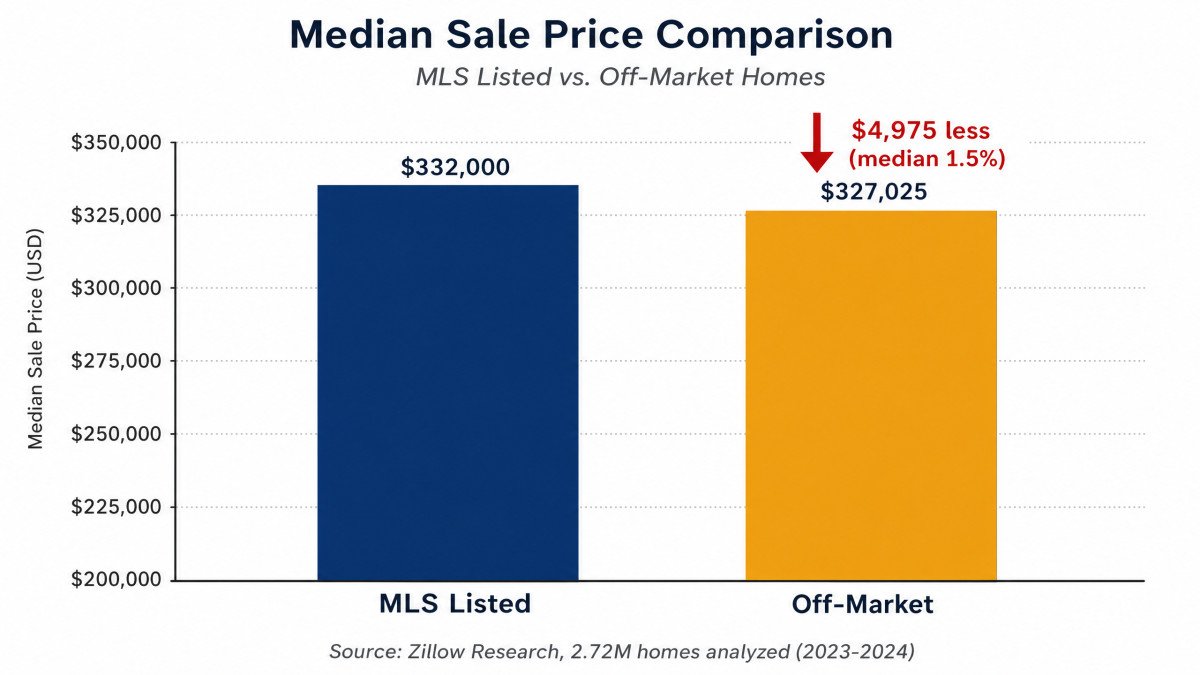
The primary motivation for buyers and investors to seek off-market properties is the potential for significant financial savings. When a property is listed on the Multiple Listing Service, it is exposed to the maximum number of potential buyers, which naturally drives up the price through competition and bidding wars. Conversely, off-market deals involve limited exposure, which often translates to a more favorable purchase price for the buyer.
A comprehensive analysis of 2.72 million home sales between 2023 and 2024 confirmed this pricing disparity. According to Zillow Research, homes sold off the MLS typically sold for $4,975 less than those listed on the MLS, representing a median loss of 1.5 percent nationwide [1]. This premium for MLS exposure is not static; it fluctuates based on market conditions and geography. In high-demand areas like California, sellers typically gave up more than $30,000 by selling off the MLS [1]. For a buyer, this means that sourcing a property off-market can result in substantial savings, effectively bypassing the inflated prices driven by retail market competition.
The same Zillow report found that sellers collectively left over one billion dollars on the table over the two-year period by forgoing broader MLS exposure [1]. While this represents a loss for sellers, it clearly illustrates the financial advantage available to buyers who successfully navigate the off-market landscape. By eliminating the competition inherent in public listings, buyers can negotiate based on the property’s intrinsic value and the seller’s specific needs, rather than competing against other retail buyers.
How to Approach Sellers Without Losing the Deal
Approaching homeowners requires a strategy focused on solving their problems rather than just making an offer. Building trust, emphasizing convenience, and presenting a clean, flexible proposal are essential for converting off-market leads into successful transactions.
Finding an off-market lead is only the first step; successfully converting that lead requires a nuanced approach. Homeowners who have not actively listed their property are often not motivated purely by achieving the highest possible price. Instead, they are usually seeking convenience, speed, and certainty. Your initial contact should never be a high-pressure sales pitch. It should be a conversation aimed at understanding their situation and determining if you can provide a viable solution.
When reaching out, lead with the benefits of a private transaction. Emphasize that selling off-market means no staging, no disruptive open houses, and no lengthy inspection contingencies. Many sellers are willing to accept a slightly lower purchase price in exchange for a guaranteed, hassle-free process. It is crucial to build trust by demonstrating that you have done your research and understand the local market. Ask questions about their timeline and what a successful outcome looks like for them.
Once you understand their needs, structure your offer to remove as much friction as possible. A clean offer — ideally cash or cash-equivalent — with a short due diligence period and flexible closing dates will always be more attractive than a complex proposal fraught with contingencies. By positioning yourself as a problem solver rather than just a buyer, you significantly increase your chances of securing the property.
Frequently Asked Questions
What’s the best way to find off-market properties?
The best way to find off-market properties is by combining targeted direct mail campaigns with driving for dollars. Utilizing skip tracing software to contact absentee owners directly allows you to reach motivated sellers before they list their homes publicly.
What month is the hardest to sell a house?
December is generally the hardest month to sell a house due to the holiday season and colder weather in many regions. Buyers are typically distracted by personal commitments, resulting in lower foot traffic and fewer offers.
What devalues a house the most?
Significant structural issues, such as foundation damage or a failing roof, devalue a house the most. Additionally, poor location, outdated major systems like plumbing and electrical, and extensive deferred maintenance drastically reduce a property’s market value.
Who usually sells off the market?
Homeowners dealing with sensitive life events, such as divorce, inheritance, or financial distress, usually sell off the market. High-profile individuals and landlords with distressed properties also prefer private sales to avoid public scrutiny and the hassle of open houses.
Final Thoughts on Securing Hidden Inventory
The real estate market has evolved, and relying solely on public listings is no longer sufficient for securing the best deals. With a substantial portion of transactions occurring outside the traditional MLS framework, proactive sourcing is mandatory. By implementing targeted direct mail, leveraging data analytics, and building strong professional networks, you can access a hidden inventory of properties. This approach not only reduces competition but also provides significant financial advantages. Success in finding off-market properties belongs to those who systematically identify opportunities and approach sellers with solutions that prioritize convenience and certainty.
References
- Zillow Research. “Off-MLS Home Sellers Left More Than $1 Billion on the Table the Past Two Years.” https://www.zillow.com/research/mls-pln-sale-price-34846/