
Home orientation determines the angle, intensity, and duration of sunlight entering a property throughout the day, points out RPM Shire Team. South-facing homes receive the most consistent, direct sunlight year-round, while north-facing properties experience softer, diffused illumination. The direction a house faces directly dictates its energy efficiency, thermal comfort, and the psychological wellbeing of its occupants.
Understanding the path of the sun is the foundation of passive solar design. The sun rises in the east, peaks in the southern sky during midday (in the Northern Hemisphere), and sets in the west. This predictable trajectory means that a room’s compass direction permanently locks in its lighting profile. A kitchen facing east will always be flooded with morning rays, whereas a west-facing living room will inevitably catch the harsh glare of the late afternoon sun.
Architects and builders rely on these principles to optimize floor plans, but homeowners often overlook them until after moving in. The quality of natural light is not uniform across a structure. Direct sunlight creates sharp shadows and intense warmth, while indirect light provides a steady, glare-free environment ideal for focused tasks. Recognizing these differences allows for strategic room placement and better utilization of available daylight.
What Home Orientation Actually Means
Home orientation refers to the positioning of a building on its site relative to true solar north, rather than magnetic north. This alignment dictates how the structure interacts with the sun’s seasonal paths and prevailing wind patterns. True solar north is the precise geographic direction of the North Pole, which is the critical metric for calculating accurate sun angles and shadow lengths.
The angle of the sun shifts dramatically between seasons. During the winter solstice, the sun sits low in the sky, casting long shadows and penetrating deep into south-facing rooms. Conversely, the summer solstice brings a high-angle sun that beats down on roofs but barely enters those same south-facing windows if proper eaves are installed. This seasonal variance is the core mechanism behind passive heating and cooling strategies.
According to the Australian Government’s YourHome guide (2024), the ideal orientation for living areas is within 15 degrees west and 20 degrees east of true solar north. This specific window allows standard eave overhangs to admit winter sun for free heating while entirely blocking the high-angle summer sun, preventing overheating without any mechanical intervention.
Failing to account for these angles results in homes that fight their environment rather than working with it. A property with extensive west-facing glazing will inevitably suffer from severe heat gain during summer afternoons, forcing air conditioning systems to work overtime. Proper orientation is the most cost-effective energy efficiency measure available, as it requires zero ongoing maintenance once the foundation is poured.
The Four Compass Directions and Their Light Profiles
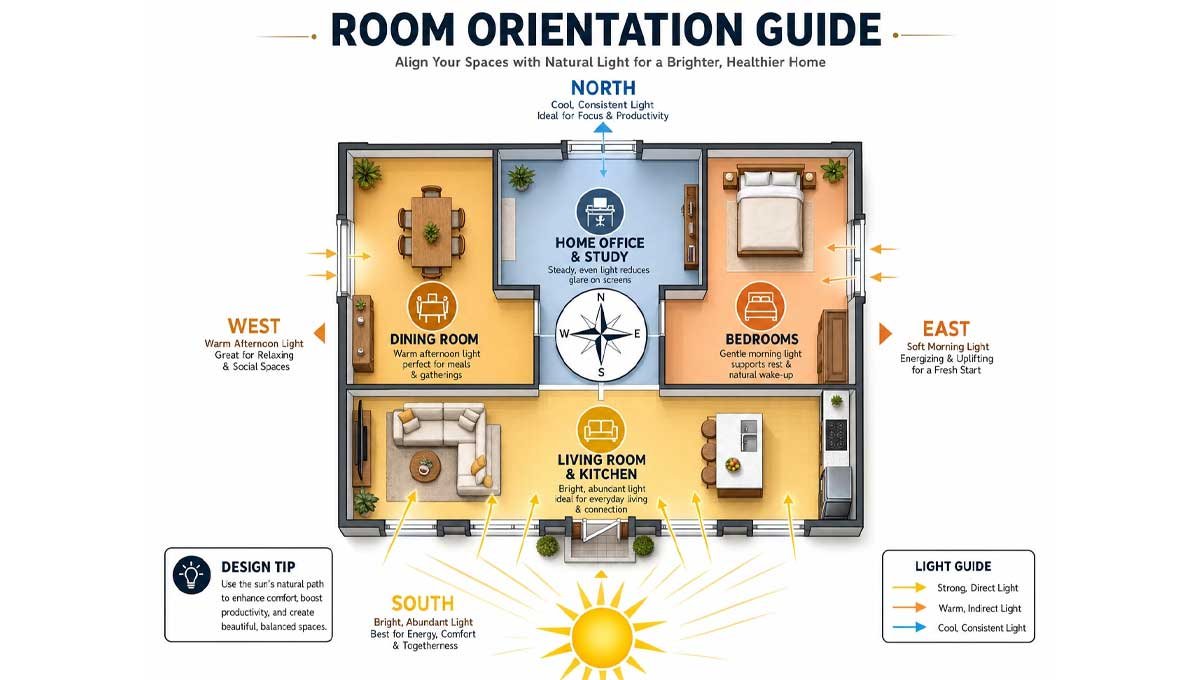
Each compass direction offers a distinct lighting profile that dictates the ambiance and utility of a room. South-facing rooms are the brightest in the house, receiving dominant daylight from late morning to mid-afternoon. This consistent, warm light renders colors accurately and intensifies hues, making it the most sought-after exposure for main living areas.
North-facing rooms are the darkest in the home, characterized by diffuse, shadowless, and slightly grayish light throughout the day and year. This constant, indirect illumination is highly prized by artists and remote workers because it eliminates harsh glare on screens and canvases. The cooler color spectrum of northern light often requires warmer paint hues and accents to make the space feel welcoming.
East-facing rooms are brightest in the morning, capturing low-altitude light that casts long, soft shadows. This morning light varies from a grey-yellow to bright white, which tends to wash out colors. Because the light fades by the afternoon, these spaces are ideal for breakfast nooks and bedrooms, supporting a natural wake-up routine while staying cool in the evening.
West-facing rooms experience their strongest light in the late afternoon and early evening, characterized by a rich gold-orange hue. This intense light penetrates deep into a structure and can be overwhelming, especially during summer months when it contributes significantly to heat gain. Cool tones are often recommended for these spaces to balance the intense warmth of the setting sun.
How Orientation Affects Energy Efficiency and Utility Costs
Strategic window placement based on orientation is a serious money-saving strategy, particularly in regions with distinct seasons. South-facing windows act as natural heaters during the fall and winter when the sun sits lower in the sky. This passive solar gain reduces reliance on furnaces and heating systems heading into the colder months.
According to Natural Resources Canada (2025), proper window orientation reduces heating costs by 10-15% annually, translating to $200-400 in savings for typical homes. Homeowners who optimize south-facing placement can see even greater reductions, sometimes cutting heating costs by up to 20%. This makes orientation one of the most impactful decisions for long-term utility expenses.
Conversely, west and southwest-facing windows present significant energy challenges. These exposures catch the intense afternoon sun when homes are already at their hottest, forcing air conditioning units to work overtime. To mitigate this, west-facing windows require specific technologies, such as a lower Solar Heat Gain Coefficient (SHGC) between 0.25 and 0.40, to block the heat while still admitting light.
Quality windows paired with strategic orientation typically pay for themselves within 8-12 years through energy savings alone. Beyond the financial return on investment, this approach provides more consistent home temperatures, reduces hot spots and cold zones, and minimizes the need for artificial lighting during the daytime.
Orientation’s Impact on Wellbeing, Sleep, and Mood
The presence of abundant natural light in residential spaces significantly influences mood enhancement, mental health, and physical comfort. Exposure to sunlight helps regulate circadian rhythms, improves sleep duration, and boosts overall vitality. For residents living through long, cloudy seasons, homes that amplify natural light can make a profound difference in daily life.
According to a 2021 study published in the International Journal of Environmental Research and Public Health, increasing circadian-effective light in residences directly affects circadian phase alignment and mental health in healthy adults. The research demonstrates that greater daylight exposure at home increases sleep duration at night and, in turn, improves decision-making and cognitive performance.
Buyers are increasingly drawn to spaces where light flows freely, creating an environment that feels energizing and uplifting. The U.S. Department of Energy notes that optimizing daylight in home design can lower lighting energy use by up to 80%, but the psychological benefits are equally compelling. Bright, airy interiors consistently sell faster and at higher prices because they support health and well-being.
Light profoundly influences how a person perceives their surroundings and whether the environment affords relaxation, spaciousness, and visual clarity. A 2024 meta-analysis on the effect of light on wellbeing indicated a small-to-moderate positive effect, confirming that natural light is a critical component of a healthy home environment.
Room-by-Room Orientation Guide
Strategic placement of rooms based on their primary function and the sun’s path maximizes comfort and usability. Living rooms thrive on southern or southeastern exposure, ensuring consistent daylight that makes these spaces warm, inviting, and energy-efficient throughout the year. This orientation captures maximum winter heat gain while providing bright, cheerful light for family activities.
Kitchens benefit most from east or southeast-facing windows, capturing morning light without the intense afternoon heat. This morning sun is perfect for a family breakfast and provides an energizing start to the day. Because kitchens generate their own heat from cooking appliances, avoiding western exposure prevents the space from becoming uncomfortably hot during summer evenings.
Bedrooms oriented to the east or south-east support natural sleep rhythms by providing gentle morning sun to aid waking, while keeping the space cool overnight. This orientation ensures the room is fresh and comfortable for restful sleep, avoiding the lingering heat of a western exposure that can disrupt evening relaxation.
Home offices and studies work best with a north or northeast-facing orientation. This provides diffused, consistent light without glare, reducing eye strain and improving productivity for remote workers. The steady illumination is ideal for computer screens and reading, making it the preferred choice for focused tasks.
| Room | Best Orientation | Why It Works |
|---|---|---|
| Living Room | South/Southeast | Maximum winter heat gain and consistent year-round light |
| Kitchen | East/Southeast | Morning light for breakfast without intense afternoon heat |
| Bedrooms | East/South | Natural wake-up light and cooler evening temperatures |
| Home Office | North/Northeast | Consistent, diffused light with no screen glare |
Compensating for Poor Orientation
Not every property boasts the ideal compass alignment, but architectural interventions can dramatically improve natural light in poorly oriented homes. Roof windows and skylights are highly effective solutions, capturing light from directly overhead and making the most of every bit of daylight, even in winter. These installations channel sunlight from above and can brighten spaces that receive little daylight from vertical windows.
For homes with excessive west-facing glazing, shading solutions are essential to prevent overheating. Overhangs sized to block summer sun but allow winter sun, adjustable awnings, and deciduous trees planted 15-25 feet from south and west windows provide summer cooling while allowing winter solar gain. These strategies mitigate the intense afternoon heat while preserving the view.
Interior design choices also play a crucial role in balancing light. In north-facing rooms with cooler, grayish light, incorporating warm paint hues and reflective surfaces can make the space feel more welcoming. Conversely, in south-facing rooms with intense, warm light, softer tones are preferred to prevent the space from feeling overly energized or visually overwhelming.
Renovating a floor plan to relocate living areas to the northern or southern side of the home, depending on the hemisphere, takes advantage of winter sun and cooling summer breezes. Increasing glazing on these preferred exposures and pruning vegetation that blocks winter sun are practical steps to optimize an existing structure’s relationship with natural light.
Real Estate Value and Orientation
Natural light is a significant factor in real estate, often translating directly into higher property values and faster sales. Homes with abundant natural light are more appealing to buyers because they enhance interior finishes, highlight architectural details, and make spaces appear more open and airy. Even smaller homes can feel expansive when light is prioritized in the design.
According to the National Association of Home Builders (2025), more than 80% of buyers rank large windows and abundant natural light as essential or desirable features in new homes. Buyers increasingly prioritize natural light over features once considered essential, such as formal dining rooms or oversized garages, reflecting a broader cultural shift toward homes designed to support health and well-being.
Investing in natural light strengthens long-term value. Homes designed with light in mind often stand out first in listings and open houses, holding enduring appeal in competitive markets. Natural light does not go out of style; it is a universal desire that continues to attract buyers year after year, making orientation a critical consideration for both builders and purchasers.
Frequently Asked Questions
What is the best orientation for a house to get natural light?
The best orientation for a house to maximize natural light is south-facing in the Northern Hemisphere. This alignment ensures the main living areas receive consistent, direct sunlight throughout the day, providing natural warmth in winter and bright, cheerful illumination year-round.
Does a north-facing house get sun?
A north-facing house receives soft, indirect, and diffused sunlight rather than harsh, direct rays. This consistent illumination is ideal for home offices and art studios because it eliminates screen glare and provides steady light without contributing to summer heat gain.
How does room orientation affect energy efficiency?
Room orientation dictates how much passive solar heating a home receives, directly impacting utility costs. South-facing windows capture free heat during winter, reducing furnace usage by 10-15%, while west-facing windows can increase air conditioning costs if not properly shaded from the intense afternoon sun.
Can window orientation be changed during renovation?
While the physical footprint of a house cannot be rotated, window orientation can be altered by adding new openings, enlarging existing ones, or installing skylights. Relocating the primary functions of rooms—such as moving a living area to a south-facing space—is a highly effective renovation strategy.
Conclusion
The impact of home orientation on natural light extends far beyond mere aesthetics, fundamentally shaping the energy efficiency, thermal comfort, and psychological wellbeing of a residence. By understanding the distinct lighting profiles of the four compass directions, homeowners and builders can strategically align living spaces to harness the sun’s predictable path. South-facing rooms offer the brightest, most consistent light and significant passive heating benefits, while north-facing spaces provide the steady, glare-free illumination essential for focused tasks. East and west exposures require careful management to balance morning cheerfulness against intense afternoon heat.
Ultimately, a home that works in harmony with its environment is more cost-effective to operate and more pleasant to inhabit. The growing real estate premium placed on natural light underscores its universal appeal and enduring value. Whether constructing a new property, undertaking a major renovation, or simply reassigning room functions, prioritizing orientation ensures that a home remains a bright, welcoming, and sustainable sanctuary for years to come.