
Property taxes are a fundamental aspect of homeownership, serving as a primary funding source for essential local government services such as public schools, infrastructure maintenance, and emergency services. While often viewed as a necessary expense, a clear understanding of how property taxes are calculated and assessed is crucial for every homeowner. This knowledge not only empowers you to anticipate costs but also provides the tools to challenge an assessment if you believe it is inaccurate. This comprehensive article will demystify property taxes and assessments, explaining key definitions, the calculation process, the assessment cycle, and how to navigate the appeals process, ultimately empowering you to be a more informed and engaged homeowner.
Defining Key Terms: Property Tax vs. Tax Assessment
Before delving into the intricacies of property taxation, it is important to differentiate between two often-interchanged terms: property tax and tax assessment.
A. Property Tax: What it is and its purpose
Property tax is an ad valorem tax, meaning it is based on the value of the property. It is levied by local governing bodies, including counties, municipalities, and school districts, to generate revenue for public services. These services directly benefit the community and include funding for local schools, police and fire departments, road construction and maintenance, parks, libraries, and other vital public amenities. Without property taxes, the quality and availability of these services would be significantly diminished, adds Rentit Colorado team.
B. Tax Assessment: The Basis of Taxation
A tax assessment refers to the official valuation placed on a property by a local government assessor for taxation purposes. This assessed value is typically a percentage of the property’s market value, which is the price a property would likely sell for under normal conditions. The assessor’s office is responsible for discovering, listing, and valuing all taxable property within its jurisdiction in accordance with state laws. The assessed value is the foundation upon which your property tax bill is calculated; a higher assessed value generally translates to a higher property tax.
How Property Taxes Are Calculated
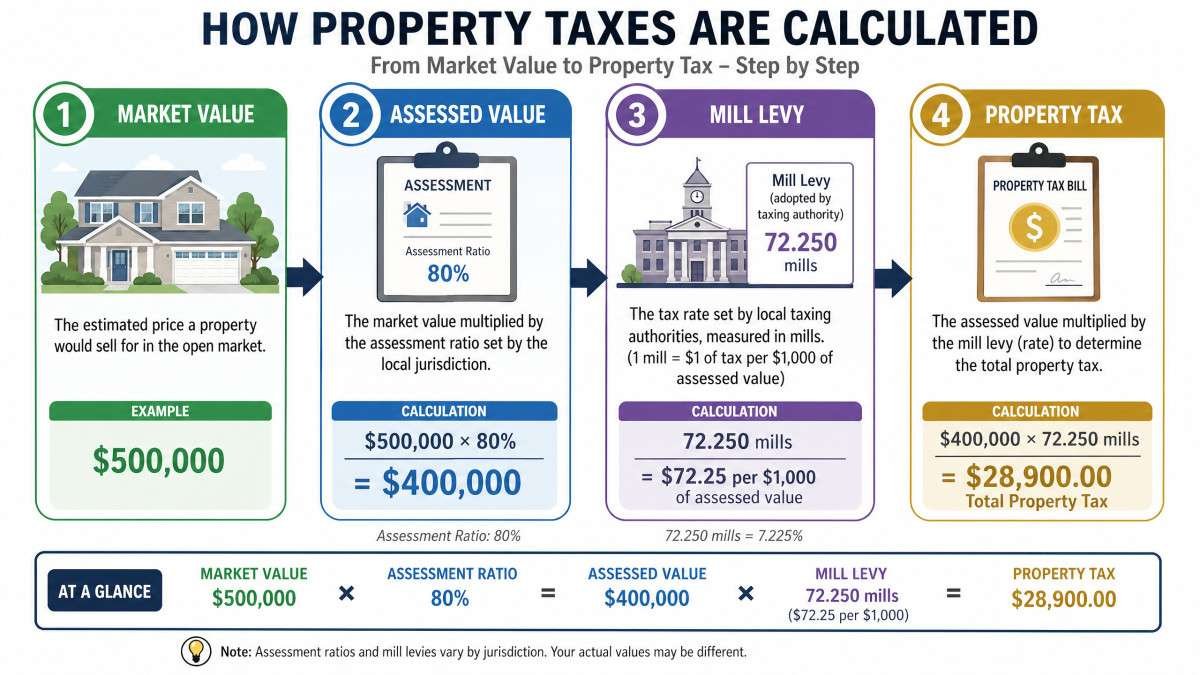
The calculation of property taxes involves a two-step process: determining the assessed value and then applying the local tax rate (mill levy).
A. The Assessment Process: Determining Value
The first step is to determine your property’s assessed value. This begins with the assessor estimating your property’s market value. Assessors use various methods, including analyzing recent sales of comparable properties in your area, considering the cost to replace your property, and evaluating its income-generating potential (for commercial properties). Once the market value is established, an assessment ratio (a percentage set by state or local law) is applied to arrive at the assessed value. For example, if your home has a market value of $300,000 and the assessment ratio is 30%, your assessed value would be $90,000 ($300,000 x 0.30).
B. The Mill Levy (Tax Rate): Local Funding Needs
The second step involves applying the mill levy, or tax rate, to your assessed value. A mill is a unit used to express the property tax rate, representing one dollar of tax for every $1,000 of assessed value, or $0.001. Local taxing authorities (e.g., school boards, city councils) determine the mill levy based on their budgetary needs. For instance, if the total mill levy in your area is 25 mills, it means you pay $25 for every $1,000 of your assessed value. Using the previous example of an assessed value of $90,000 and a 25-mill levy, your annual property tax would be $2,250 ($90,000 / 1,000 x 25).
C. Factors Influencing Property Tax
Several factors can influence your property tax bill. These include the property’s location (different jurisdictions have different tax rates), its size and features (larger homes with more amenities generally have higher values), any improvements made to the property (which can increase its market and assessed value), and recent sales data in your neighborhood (which assessors use to gauge market trends).
The Property Assessment Cycle and Notification
Property assessments are not static; they are part of a recurring cycle designed to keep property values current with market conditions.
A. Regular Assessment Cycles
The frequency of property reassessments varies by state and local jurisdiction, typically ranging from annually to every few years. These cycles ensure that property values reflect current market conditions, which can lead to adjustments in your assessed value and, consequently, your property tax bill. It’s important to be aware of your local assessment cycle to anticipate potential changes.
B. Notice of Assessment
When your property is reassessed, you will receive a Notice of Assessment (or similar document) in the mail. This notice is crucial as it details your property’s new assessed value, the market value estimate, and often includes information on how to appeal the assessment. It also specifies the deadline for filing an appeal. Reviewing this notice carefully is your first line of defense against an inaccurate assessment.
Appealing Your Property Tax Assessment
If you believe your property’s assessment is incorrect, you have the right to appeal it. A successful appeal can lead to a reduction in your property tax bill.
A. Grounds for Appeal
Common grounds for appealing a property tax assessment include:
- **Inaccurate Property Data:** The assessor’s records contain errors regarding your property’s characteristics (e.g., incorrect square footage, number of bedrooms/bathrooms, lot size).
- **Unequal Assessment:** Your property is assessed at a higher percentage of market value than comparable properties in your neighborhood.
- **Overvaluation:** Your property’s assessed value is significantly higher than its actual market value.
B. The Appeal Process: Step-by-Step
The appeal process generally involves several stages:
- **Review Your Assessment and Deadlines:** Carefully examine your Notice of Assessment for errors and note the deadline for filing an appeal, which is typically strict.
- **Gathering Evidence:** Collect supporting documentation, such as recent sales data for comparable properties (comps) in your area, a professional appraisal, photos of any defects, or repair estimates.
- **Informal Review:** Many jurisdictions offer an informal review process where you can meet with the assessor’s office to discuss your concerns and present your evidence. This can often resolve issues without a formal appeal.
- **Formal Appeal:** If an informal review is unsuccessful, you can file a formal appeal with a local review board (e.g., Board of Equalization or Assessment Review Board). This typically involves a hearing where you present your case.
- **Further Appeals:** If you are still not satisfied with the decision of the local review board, you may have options for further appeals to state-level bodies or the courts, depending on your jurisdiction.
C. Tips for a Successful Appeal
To increase your chances of a successful appeal, be prepared, organized, and polite. Focus on factual data and comparable properties rather than emotional arguments. Understand the specific criteria and procedures for appeals in your jurisdiction.
Exemptions and Tax Relief Programs
Many jurisdictions offer exemptions and tax relief programs that can reduce your property tax burden.
A. Common Exemptions
These can include homestead exemptions (for owner-occupied primary residences), exemptions for senior citizens, veterans, and individuals with disabilities. These programs typically reduce the assessed value of your property, thereby lowering your tax bill.
B. How to Apply for Exemptions
Eligibility criteria and application processes vary by jurisdiction. It is essential to research the available programs in your area and apply by the specified deadlines. Often, you will need to provide documentation to prove your eligibility.
Conclusion: Empowering Homeowners
Understanding property taxes and assessments is an integral part of responsible homeownership. By familiarizing yourself with how these taxes are calculated, the assessment process, and your rights as a taxpayer, you can ensure that your property is fairly valued and that you are not overpaying. Proactive engagement, from reviewing assessment notices to exploring available exemptions, empowers you to manage your homeownership costs effectively and contribute to the vital local services that make your community thrive.