
The quest for a truly sustainable home often begins with solar arrays, smart thermostats, and high-efficiency appliances. However, for many homeowners, a significant energy leak remains hidden beneath the surface of the backyard swimming pool. Historically, pool maintenance has been a “brute force” operation—relying on high-voltage pumps running for eight to ten hours a day to power inefficient suction-side cleaners. In 2026, the paradigm is shifting from raw power to intelligent navigation. As we move toward an energy-conscious future, “Intelligent Path Planning” is emerging as the most significant technological leap in reducing the carbon footprint of the modern residential ecosystem.
How Intelligent Path Planning Reduces Residential Energy Consumption
Traditional cleaning systems are notoriously inefficient because they lack a spatial sense of their environment. Suction and pressure-side cleaners typically operate on a “random walk” algorithm, bouncing off walls and wandering aimlessly. This results in some areas being scrubbed repeatedly while others remain untouched, forcing the homeowner to run the primary filtration pump far longer than necessary.
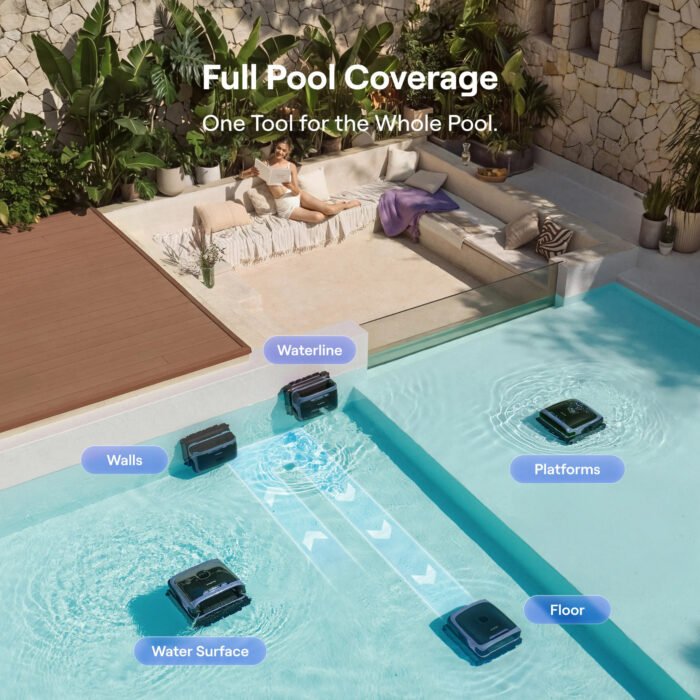
Industry analysts have noted that switching to a high-efficiency robotic pool vacuum is a structural solution to this energy waste. Systems developed by industry leaders like Beatbot utilize advanced sonar-based mapping and path planning to “understand” a pool’s geometry. By calculating the most efficient route, these devices can cover 100% of the surface in a fraction of the time required by legacy systems. When the cleaning process is optimized through intelligence rather than repetition, the total energy draw for maintenance drops precipitously, allowing the home’s primary pump to return to its low-RPM baseline sooner.
The Financial Logic of Robotic Pool Cleaners for Inground Pools

To quantify the impact of intelligent navigation, one must look at the energy draw of the home’s infrastructure. A standard 1.5 HP single-speed pool pump is one of the most energy-intensive appliances in a home, often drawing between 1.8 and 2.2 kWh per hour. In many regions, the pool’s filtration system accounts for 15% to 25% of the total summer electricity load. For homeowners relying on the main pump to power manual or suction tools, the avoidable energy costs can exceed $100 per month.
The transition to specialized robotic pool cleaners for inground pools represents a decoupling of cleaning from circulation. Furthermore, the shift to a dedicated cordless robotic pool cleaner further enhances energy independence by utilizing low-voltage DC motors that are fundamentally more efficient than central plumbing requirements. Manufacturers are now engineering these autonomous units to operate as “silent infrastructure.” Energy estimates suggest that by delegating debris collection to an intelligent robotic unit, homeowners can reduce primary pump runtime by up to 30%, effectively stopping a direct financial and environmental leak in their household budget.
Protecting Infrastructure and Reducing Chemical Dependency
Beyond immediate energy savings, intelligent path planning serves as a protective measure for the pool’s physical infrastructure. In environments prone to fine sediment or organic debris, allowing particles to sit on the floor is more than an aesthetic issue; it is an abrasive force. Regional contractors often report that resurfacing cycles can shorten to five-to-seven years on neglected pools, leading to avoidable five-figure expenses.
Independent robotic systems prevent this degradation by ensuring consistent, edge-to-edge cleaning. By capturing fine silt and organic matter in onboard micro-filters, these devices also stabilize water chemistry. When debris is removed before it breaks down and triggers algae blooms, the need for aggressive “shock” treatments and heavy chlorination is drastically reduced. This creates a virtuous cycle: less organic matter leads to fewer chemicals, which leads to less water-wasting “backwashing” of the primary filter. In an era of increasing water conservation mandates, maintaining clarity with minimal intervention is a critical component of a truly eco-friendly home.
The Shift Toward Autonomous Asset Preservation
By the time the sun rises on a typical summer morning, the difference between a reactive home and an automated one is visible in the water. In one backyard, the owner is preparing for a Saturday of manual labor—dragging out hoses and checking chemical levels to compensate for a week of inefficient cleaning. In the other, the home has functioned as a self-maintaining ecosystem.
The choice to integrate intelligent path planning into pool care is a decision about resource leverage. In 2026, the trend is moving toward infrastructure that works silently in the background to preserve both time and energy. As manufacturers continue to refine sonar navigation and autonomous efficiency, the benchmark for a well-managed property is no longer the size of the pool, but the intelligence of the systems that preserve it. On the quest for a carbon-neutral lifestyle, the smartest money is spent on the technology that eliminates waste before it begins. The homes that age best are those that automate early.