
Let’s be real for a second. You’ve probably spent the last three weeks scrolling through Pinterest, saving photos of “minimalist floating decks” and convincing yourself you can get it done for a few grand and a weekend of sweat equity.
Stop.
I’ve been in this game long enough to see the pattern. You set a budget, you double it, and you still end up eating instant noodles for a month to pay for the handrails you forgot to price in. In 2026, the game has changed. Labor shortages are tighter than ever, and material costs aren’t what they were five years ago.
If you want a deck that doesn’t turn into a money pit—or a pile of rotting lumber—you need to look at the costs nobody talks about until the invoice hits your inbox.
Deck Site Preparation Costs & Excavation Fees
Everyone obsesses over the pretty stuff—the boards, the lights, the fire pit. Almost no one thinks about the dirt.
Unless your backyard is perfectly flat (it isn’t) and chemically sterile (it isn’t), you are going to pay for site preparation. In 2026, excavation costs have crept up significantly. We aren’t just talking about digging a few holes for posts. We’re talking about grading the land so water doesn’t pool under your structure and rot the joists from the bottom up.
I had a job recently where we hit hard clay mixed with rock. The client budget for “site prep” was $500. The actual cost to bring in the machinery and haul the debris away? Closer to $2,500. If you don’t budget for a dumpster and a mini-excavator, you are already behind before the first board goes down.
Composite Decking Panels vs. Wood: 2026 Price Comparison
Here is the biggest lie in decking: “Wood is cheaper.”
Sure, on day one, a pressure-treated pine deck is cheaper. But let’s look at the 2026 reality. The price gap between high-quality lumber and composite decking panels has narrowed, but the maintenance gap has widened.
Wood is needy. It’s the high-maintenance partner of building materials. You have to stain it. Seal it. Sand it. And if you skip a year? It splinters.
I see homeowners look at the price tag of composite decking panels—which can run $12 to $22 per square foot for the material alone—and balk. They go with wood to save $3,000 upfront. But then they spend $400 a year on stain, sealers, and weekends of back-breaking labor.
By year five, the wood deck looks tired. The composite deck looks exactly the same as the day it was installed. If you value your weekends, the “hidden cost” of wood is your own free time.
Coastal Decking Maintenance & Material Durability
Location matters more than you think. If you live anywhere near the coast, the air is actively trying to destroy your investment.
Take a place like the Northern Rivers in NSW. It’s beautiful, but the salt air is brutal on fasteners and cheap timber. I once joked with a client that he needed a financial advisor Ballina locals trust just to calculate the depreciation on his softwood deck.
He laughed, but he shouldn’t have. He used standard galvanized screws instead of high-grade stainless steel. Three years later, the screws rusted out, the boards popped loose, and he was looking at a total rebuild. A smart financial advisor in Ballina (or any coastal town) would tell you that “cheap” is expensive. If you are within ten miles of the ocean, upgrade your hardware. It’s a hidden cost that saves the entire structure.
Deck Building Permits & Zoning Laws in 2026
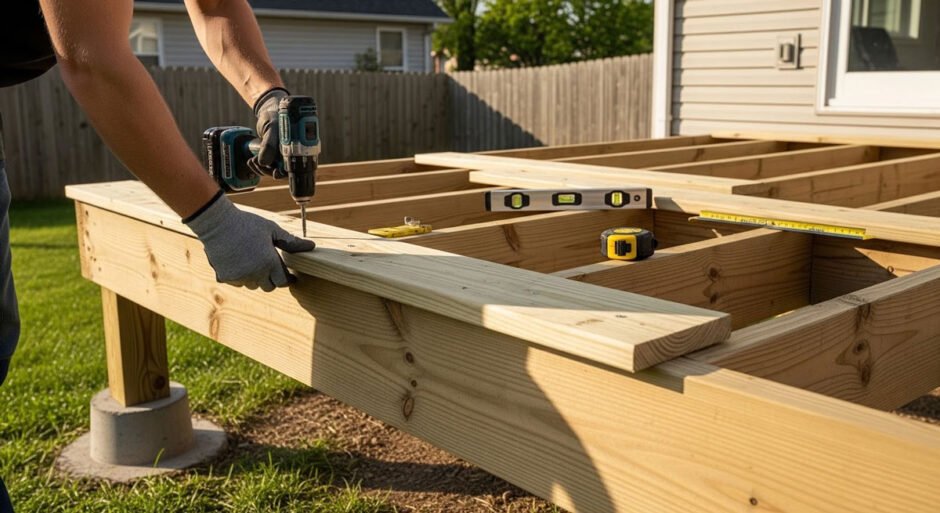
In 2026, local councils and municipalities are not messing around. The days of building a “structure” in your backyard and hoping nobody notices are over.
Drone inspections and updated zoning laws mean you need to be legit. Permits can easily run $500 to $1,000 depending on your location and the complexity of the build. And that’s just the fee. The real cost is the delay.
If your permit gets stuck in approval hell for six weeks, your contractor might move on to another job. Now you’re paying a premium to get them back on schedule, or you’re stuck paying for materials that are sitting in your driveway getting rained on.
Scope Creep & Hidden Deck Budget Overruns
This is the budget killer.
You start building the deck. It looks great. Then you realize, “Hey, it’s kinda dark out here.” Suddenly, you’re running low-voltage wiring for stair lights ($1,500). Then you realize the old sliding door looks trash next to the new deck, so you replace that ($3,000).
Then you decide you need a pergola because the sun is too hot ($5,000).
I call this “Scope Creep,” and it accounts for about 20% of the final cost on almost every project I see. You need a contingency fund. Not 5%. You need 20%.
Final Cost Breakdown for Building a Deck
Building a deck in 2026 isn’t just about buying wood and screws. It’s about labor shortages, expensive dirt, long-term maintenance, and government fees.
If you are serious about this:
- Get three quotes, and throw out the lowest one.
- Price out composite decking panels and calculate the 10-year cost, not the day-one cost.
- Add 20% to your total budget for the things you can’t see yet.
Do it right the first time, or don’t do it at all.