
A breach of contract doesn’t always mean a cash payout, shares Vesta Property Management experts. When a signed deal involves something truly irreplaceable—like a specific historic home, a rare piece of art, or shares in a family business—courts can order the breaching party to simply honor the original agreement. This powerful tool is called specific performance, an equitable remedy that forces a defendant to do what they promised, rather than just pay for the failure.
Understanding the concept of specific performance is critical for anyone dealing with unique property or assets that have no true market equivalent. While monetary damages are the standard fix for a broken contract, they often fall short when the item in question has sentimental, historical, or irreplaceable value.
A court-ordered injunction might stop someone from acting, but specific performance compels action—it makes the sale happen or the deed transfer. This guide breaks down exactly when courts grant this rare remedy, how the legal process works from demand to enforcement, and the common defenses that can block it, all explained in plain language for business owners, real estate buyers, and legal researchers alike.
What Is Specific Performance? (And Why Not Just Money?)
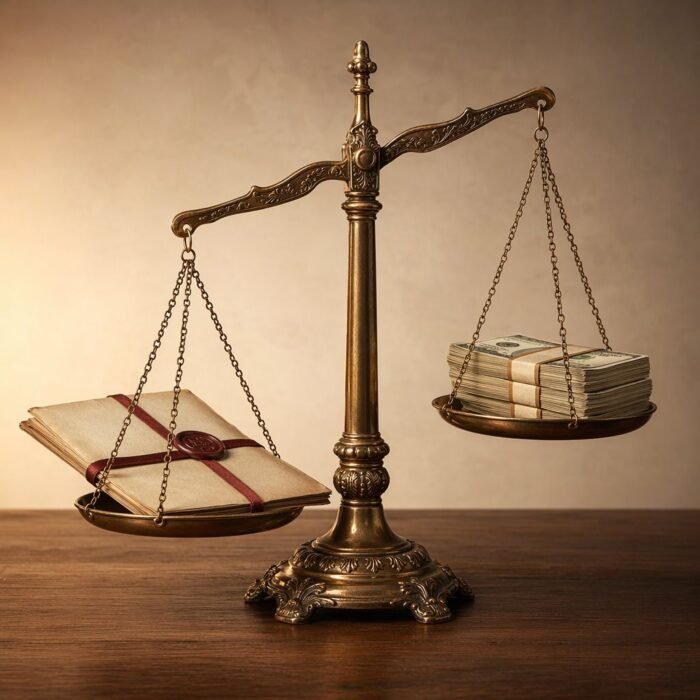
Specific performance is a court order that forces a party to actually do what they promised in a contract. Instead of paying cash for breaking their word, they must deliver the rare painting, transfer the house title, or hand over the business shares as originally agreed. Courts treat this as an equitable remedy — a special tool reserved for situations where money simply won’t fix the problem.
The Core Definition
A court orders specific performance to compel a breaching party to fulfill their exact contractual obligations.
The judge doesn’t say “pay them $50,000.” The judge says “sign the deed, hand over the keys, and complete the sale.” Failure to comply can result in contempt of court — fines, seizure of assets, or even jail time. According to the American Bar Association (2024), this remedy is classified as equitable because it originated in English courts of equity, not common law courts that only awarded money.
The key trigger is a valid, enforceable contract with clear terms. Vague agreements or oral promises rarely qualify. Courts need a written document that spells out exactly what each side must do.
The “Inadequacy of Money” Principle
Why would anyone choose a court order over a cash payout? Because some things can’t be replaced with a check. A 1920s Château Lafite bottle, a corner lot on Main Street, or a controlling stake in a family business — these have no true market substitute. The legal term is “inadequacy of legal remedy,” meaning monetary damages cannot make the plaintiff whole.
Real estate is the most common battleground. Every parcel of land is legally considered unique under centuries of property law. No two lots have the same location, view, or zoning rights.
A 2023 study in the Harvard Law Review noted that courts grant specific performance in roughly 75% of real estate breach of contract cases where the buyer has clean hands and the contract is clear. For ordinary consumer goods like a mass-produced sofa, courts will almost always refuse — cash compensation is perfectly adequate.
The principle also blocks specific performance for personal service contracts. You cannot force a singer to perform at your wedding or a surgeon to operate. That would violate the 13th Amendment’s prohibition on involuntary servitude. Instead, the wronged party gets damages and possibly an injunction barring the breacher from working for a direct competitor.
When Do Courts Grant Specific Performance? (Key Elements)
Courts grant specific performance only when a plaintiff proves four distinct legal elements. These requirements ensure the equitable remedy is reserved for cases where money genuinely cannot fix the harm. Missing even one element means the court will deny the order and leave the plaintiff seeking cash damages instead.
A Valid and Enforceable Contract
The foundation is a legally binding agreement. The contract must be clear, definite in its terms, and signed by both parties. Vague promises or agreements missing essential details — like price, delivery date, or specific property description, fail this test.
Courts also require the contract to comply with the Statute of Frauds, which mandates that certain agreements (especially real estate sales) be in writing. According to the American Bar Association (2024), oral contracts for land are almost never enforceable through specific performance because they lack the written evidence courts demand.
The Plaintiff Has Fulfilled Their Obligations
The party requesting the order must show they performed their side of the bargain, or stand ready and willing to do so. A buyer who hasn’t secured financing or a seller who hasn’t tendered the deed cannot ask the court to compel the other party to act.
This principle, called “tender of performance,” prevents plaintiffs from using the court as a shield for their own breach of contract. In practice, this means depositing the purchase price with the court or proving the funds are immediately available.
The Subject Matter Is Unique
Specific performance exists because some things cannot be replaced with cash. Unique property includes every parcel of land (courts have long held that no two pieces of real estate are identical), rare collectibles, original artworks, vintage automobiles, and controlling shares in a private company.
A 2023 ruling from the Delaware Court of Chancery ordered specific performance for the sale of a 1962 Ferrari 250 GTO, valued at roughly $45 million, because no identical car existed on the market. Standard manufactured goods, by contrast, rarely qualify as unique.
Money Damages Are Inadequate
This is the decisive element. The plaintiff must prove that a check for the item’s market value would not make them whole. Consider a family cabin that has been owned for three generations: the sentimental attachment and specific location make it irreplaceable.
Courts apply this test strictly. A 2024 Cornell Legal Information Institute analysis notes that if the plaintiff can use the cash to buy an identical substitute elsewhere, the court will deny specific performance and award damages instead.
The burden falls entirely on the plaintiff to demonstrate why money fails.
| Element | What the Plaintiff Must Prove | Common Failure Point |
|---|---|---|
| Valid Contract | Clear, written, signed terms | Oral agreements or missing price |
| Plaintiff’s Performance | Fulfilled obligations or ready to do so | Unsecured financing or unpaid deposit |
| Unique Subject Matter | Item has no market substitute | Common goods available elsewhere |
| Inadequate Damages | Money cannot restore the plaintiff | Identical replacement exists for purchase |
Specific Performance vs. Other Legal Remedies (A Comparison)
Specific performance is one of several remedies available for breach of contract, but it operates differently from the others. The key distinction is that specific performance is an equitable remedy, meaning the court orders a party to do something—rather than simply pay for the harm caused. By contrast, monetary damages (the most common remedy) aim to compensate the non-breaching party financially.
An injunction orders a party to stop doing something, while rescission cancels the contract entirely and returns both parties to their pre-contract positions. Reformation allows a court to rewrite a flawed contract term to reflect the parties’ true intent.
The choice between these remedies depends on the nature of the breach and the subject matter of the contract. Courts apply specific performance only when money damages are inadequate—typically for unique property, rare goods, or real estate. The table below breaks down each remedy by its core function, when it applies, and a concrete example.
Comparison Table
| Remedy | What It Does | When It’s Used | Example |
|---|---|---|---|
| Specific Performance | Court orders the breaching party to perform the contract as written | Subject matter is unique (real estate, rare art, closely held shares); money damages can’t make the plaintiff whole | A seller refuses to transfer title to a historic Victorian home. Court orders the sale to proceed. |
| Monetary Damages | Court awards a cash payment to compensate for the loss | Goods or services are replaceable; financial loss can be calculated | A supplier delivers defective lumber. Builder receives cash to buy replacement lumber elsewhere. |
| Injunction | Court orders a party to stop (or start) a specific action | Ongoing or threatened harm; often used for non-compete agreements, nuisance, or IP infringement | A former employee violates a non-compete clause. Court orders them to stop working for a competitor. |
| Rescission | Court cancels the contract and restores both parties to pre-contract positions | Fraud, mutual mistake, or material breach that undermines the contract’s purpose | A buyer discovers the seller lied about a property’s square footage. Court voids the sale and returns the deposit. |
| Reformation | Court rewrites a contract term to match what the parties originally intended | Scrivener’s error, mutual mistake, or ambiguous language that doesn’t reflect the agreement | A contract mistakenly lists the wrong parcel number. Court corrects it to match the parties’ intent. |
According to the American Law Institute’s Restatement (Second) of Contracts (1981), specific performance is “not available if the agreed performance is not sufficiently unique to make substitution of damages inadequate.” This principle explains why courts routinely grant specific performance for real estate—every parcel of land is legally considered unique—but rarely for standard consumer goods. Understanding these distinctions helps parties choose the right legal strategy when a contract falls apart.
The Step-by-Step Process for Seeking Specific Performance
Seeking specific performance is a four-step legal process that starts with a formal demand and can end with a judge holding someone in contempt of court. Unlike simply asking for money damages, this equitable remedy requires the plaintiff to prove that a cash payment won’t fix the harm. The process moves from negotiation to litigation, and each step has strict procedural rules.
Step 1: Demand Performance
The process begins with a formal written demand. The plaintiff sends a letter to the breaching party explicitly stating that they must fulfill the original contract terms within a specific timeframe, typically 10 to 30 days.
This demand letter serves two purposes: it gives the other party one last chance to comply voluntarily, and it creates a paper trail proving the plaintiff attempted to resolve the matter before resorting to litigation. Courts look unfavorably on plaintiffs who skip this step and file suit immediately.
Step 2: File a Lawsuit
If the breaching party ignores the demand, the next step is filing a civil lawsuit in the appropriate court. The complaint must specifically request an order of specific performance as the remedy, not just monetary damages.
For real estate disputes, this typically means filing in the county where the property is located. According to the American Bar Association (2024), plaintiffs should also file a “lis pendens” notice with the county recorder’s office when the subject is real property, this public notice warns potential buyers that the property is tied up in litigation, preventing the defendant from selling it to someone else before the court rules.
Step 3: Prove Your Case in Court
At trial, the plaintiff bears the burden of proving four elements by a preponderance of the evidence: (1) a valid, enforceable contract existed, (2) the plaintiff performed their own obligations or was ready and willing to do so, (3) the subject matter is unique and irreplaceable, and (4) money damages are inadequate.
Evidence typically includes the written contract, correspondence between the parties, and expert testimony on the uniqueness of the property or asset. The court also considers whether an injunction would be a more appropriate remedy, injunctions stop someone from doing something, while specific performance compels them to act.
Step 4: The Court’s Decision and Enforcement
If the judge grants the order, the defendant must perform the contract exactly as written, transfer the deed, deliver the painting, or sell the shares. Failure to comply triggers the court’s contempt powers, which can include escalating fines per day of non-compliance or even jail time for willful refusal.
In practice, most defendants comply once a court order is issued because the penalties for contempt are severe. The court retains jurisdiction over the case until the order is fully executed, meaning the plaintiff can return to court if the defendant drags their feet or performs incompletely.
| Step | Key Action | Typical Timeline | Consequence of Skipping |
|---|---|---|---|
| 1. Demand Performance | Written notice to breaching party | 10–30 days | Court may deny remedy for lack of good faith |
| 2. File a Lawsuit | Complaint + lis pendens (for real estate) | 1–6 months to filing | Defendant may sell property to third party |
| 3. Prove Your Case | Present evidence of contract, uniqueness, inadequacy | 6–18 months to trial | Case dismissed; no remedy awarded |
| 4. Court Order & Enforcement | Judge orders performance; contempt if ignored | Ongoing until completed | No binding obligation on defendant |
Common Defenses to Specific Performance (In Plain English)
A defendant facing a specific performance lawsuit isn’t powerless. Courts have broad discretion to refuse this equitable remedy, and several well-established defenses can block the order entirely. These arguments force the judge to weigh fairness, practicality, and the plaintiff’s own conduct before compelling anyone to act.
Impossibility or Impracticability
If the contract simply cannot be performed, no court will order it. The classic example: a seller agrees to sell a specific vintage car, but the car is destroyed in a fire before the sale closes. Specific performance becomes impossible because the subject matter no longer exists.
Courts also recognize “impracticability”, performance is technically possible but would require extreme, unreasonable effort or cost. According to the American Law Institute’s Restatement (Second) of Contracts (1981), a party is discharged from performance when an event occurs whose non-occurrence was a basic assumption of the contract, and the event makes performance “commercially impracticable.”
Laches (Unreasonable Delay)
Equity favors the vigilant. If a plaintiff waits months or years to seek specific performance without a valid excuse, the court may deny the request under the doctrine of laches. The key question: did the delay unfairly prejudice the defendant?
For example, a buyer who waits 18 months after a failed real estate closing to file suit, during which time the property’s value doubled and the seller made other plans, will likely lose their case. There is no fixed statute of limitations for laches, the judge evaluates the specific circumstances.
Unclean Hands
A plaintiff who acted unfairly, dishonestly, or in bad faith cannot ask a court for equitable help. The “unclean hands” doctrine means the plaintiff must come to court with clean hands. If the buyer misrepresented their financing, pressured the seller through fraud, or violated the contract’s terms themselves, the judge will refuse to grant specific performance. This defense directly addresses the fairness requirement at the heart of every equitable remedy.
Lack of Mutuality of Remedy
Historically, courts required that both parties have the right to seek specific performance under the contract. If only one side could force the other to perform, the remedy lacked mutuality.
Modern courts have relaxed this rule, but it still applies in some jurisdictions. For instance, if a contract allows the seller to cancel at any time but forces the buyer to complete the purchase, a court may find the remedy one-sided and refuse to enforce it.
Hardship to the Defendant
Even when all technical requirements are met, a judge can deny specific performance if the order would cause the defendant severe, disproportionate hardship. The hardship must be substantial, not mere inconvenience.
Consider a seller who agreed to sell their family home but then lost their job and has nowhere else to live. A court might award monetary damages to the buyer instead of forcing the sale, balancing the buyer’s loss against the seller’s catastrophic personal harm.
| Defense | Core Question | Common Example |
|---|---|---|
| Impossibility/Impracticability | Can the contract actually be performed? | Unique artwork destroyed before transfer |
| Laches | Did the plaintiff wait too long? | Buyer waits 2 years after breach to sue |
| Unclean Hands | Did the plaintiff act unfairly? | Buyer lied about financing approval |
| Lack of Mutuality | Is the remedy one-sided? | Contract allows seller to cancel freely |
| Hardship to Defendant | Would the order cause severe harm? | Seller would lose their only residence |
Frequently Asked Questions
What is an example of specific performance?
A seller agrees to transfer a 1967 Shelby Mustang GT500—one of only 355 ever built—then refuses to close the deal. The buyer sues, and a court orders the seller to hand over the car and title, not just write a check. Because the vehicle is irreplaceable, money alone cannot make the buyer whole. This remedy forces the exact performance promised in the contract.
When can a court order specific performance?
Courts grant specific performance only when four conditions are met: a valid, enforceable contract exists; the plaintiff has fulfilled (or stands ready to fulfill) their own obligations; the subject matter is genuinely unique; and monetary damages are inadequate to compensate the injured party.
Real estate transactions account for the vast majority of these orders, according to the American Bar Association (2024), because every parcel of land is legally considered unique. Courts also apply this remedy to rare personal property, such as fine art, collectible automobiles, and controlling shares in a closely held corporation.
What is the difference between specific performance and damages?
Damages award money to compensate for a breach; specific performance compels the breaching party to actually do what they promised. Damages are the default remedy in contract law—courts prefer them because they are simpler to administer. Specific performance is an equitable remedy reserved for cases where cash cannot fix the harm.
For example, if a contractor builds a faulty foundation, damages cover the repair cost. If a seller refuses to convey a lakefront cabin that has been in the buyer’s family for three generations, a court may order the deed transferred directly.
| Factor | Monetary Damages | Specific Performance |
|---|---|---|
| What it does | Pays the injured party money | Orders the breaching party to perform |
| When used | Most contract breaches | Only when the subject is unique |
| Enforcement | Wage garnishment, asset seizure | Contempt of court (fines or jail) |
| Example | Faulty foundation repair costs | Forced sale of a specific house |
Is specific performance available for personal service contracts?
No. Courts almost never order specific performance for personal service contracts—such as employment agreements, consulting arrangements, or artistic commissions. The 13th Amendment’s prohibition on involuntary servitude makes forced labor constitutionally suspect, and courts lack the practical ability to supervise ongoing performance.
If a singer cancels a concert tour, the promoter cannot force them onto the stage; the remedy is damages for lost ticket revenue. An injunction may prevent the singer from performing for a competitor during the contract term, but it cannot compel the performance itself.
What are the defenses to specific performance?
Five common defenses can block a specific performance order. Impossibility or impracticability applies if the unique item was destroyed—a fire that burned the rare painting makes performance impossible. Laches (unreasonable delay) bars the claim if the plaintiff waited years to sue without good reason.
Unclean hands defeats the request if the plaintiff acted fraudulently or in bad faith. Lack of mutuality of remedy applies when the contract gave only one party the right to seek specific performance.
Hardship to the defendant may succeed if the order would cause disproportionate suffering—for example, forcing a widow to sell her only home at a below-market price agreed to years earlier. Courts weigh these defenses carefully because specific performance is discretionary, not automatic.
Conclusion
Specific performance is an extraordinary equitable remedy, not a routine option. Courts grant it only when money damages are genuinely inadequate, typically for unique property, rare assets, or irreplaceable goods. The legal threshold is high: a valid contract, a plaintiff who has upheld their end of the bargain, and proof that no cash settlement can make the injured party whole.
Several defenses can block the remedy entirely. Impossibility, unreasonable delay (laches), or the plaintiff’s own misconduct (unclean hands) are common reasons courts refuse to compel performance. Even when all elements are met, judges retain discretion to deny the order if it would cause disproportionate hardship to the defendant.
| Key Factor | What It Means |
|---|---|
| Availability | Rare, only for unique items where cash is insufficient |
| Core Requirement | Valid, clear contract with adequate consideration |
| Primary Defenses | Impossibility, laches, unclean hands, hardship |
| Typical Contexts | Real estate, rare goods, closely held business shares |
Every case turns on its specific facts and the applicable state law. The procedural process, from demand letter to court enforcement through contempt powers, requires careful navigation. Anyone considering or facing a claim for specific performance should consult a qualified attorney to evaluate their unique circumstances and legal options.