
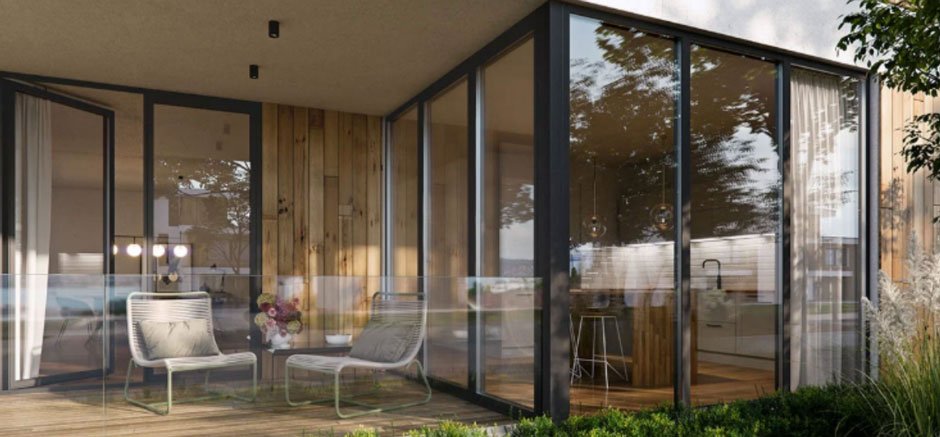
Aluminum windows offer thin frames, large glass areas, and exceptional durability. They’re popular in modern architecture and commercial buildings. But aluminum has a fundamental problem: it conducts heat extremely well. A solid aluminum frame creates a direct thermal bridge from outside to inside, causing heat loss, condensation, and poor energy performance.
Thermal breaks address this by inserting a non-conductive material into the frame, interrupting the heat flow path. This technology has been used since the 1970s, but modern formulations and manufacturing techniques have significantly improved performance. Here’s what you need to know about thermally broken aluminum windows—including when they make sense and when they don’t.
How Thermal Breaks Work
Aluminum has exceptional thermal conductivity: 160-200 W/(m·K). For comparison, vinyl (PVC) has conductivity of 0.17 W/(m·K)—about 1000 times less conductive. This means heat flows through aluminum essentially unimpeded.
A thermal break is a section of low-conductivity material inserted between the interior and exterior portions of the aluminum frame. Common materials
Polyamide (nylon) with fiberglass reinforcement: Most common. Thermal conductivity ~0.3 W/(m·K). Strong enough to maintain structural integrity while dramatically reducing heat flow.
Polyurethane: Sometimes used in poured-and-debridged systems. Conductivity ~0.02-0.03 W/(m·K). Better insulation but more complex manufacturing.
The thermal break typically spans 15-40mm of the frame width. Wider breaks provide better insulation but increase frame width and cost. The break must be strong enough to handle structural loads while remaining non-conductive—a challenging engineering balance.
Assembly methods
Crimped/rolled: Polyamide strips are inserted into grooves in the aluminum profiles, then the aluminum is crimped around them. Strong mechanical connection.
Poured-and-debridged: Polyurethane is poured into a channel in a continuous aluminum profile, then aluminum is machined away (debridged) to create two separate sections connected only by the polyurethane. Labor-intensive but achieves narrower sight lines.
Performance Improvements: The Numbers
The thermal break dramatically improves frame thermal performance
Uf-value (frame U-factor) comparison
- Standard aluminum (no thermal break): 5.0-7.0 W/(m²K)
- Thermally broken aluminum (15mm break): 2.5-3.5 W/(m²K)
- Thermally broken aluminum (25mm break): 1.8-2.5 W/(m²K)
- Thermally broken aluminum (35mm+ break): 1.2-1.8 W/(m²K)
- Vinyl/uPVC frame: 1.0-1.3 W/(m²K)
- Wood frame: 1.3-1.8 W/(m²K)
The improvement is substantial compared to non-broken aluminum, but thermally broken aluminum still generally performs worse than vinyl for pure thermal insulation. The advantage of aluminum is structural—it can support much larger glass areas with thinner frames.
Whole-window performance depends on the glass
For a typical window (60% glass, 40% frame)
- Thermally broken aluminum + double-pane Low-E: Uw = 1.6-2.0 W/(m²K)
- Thermally broken aluminum + triple-pane Low-E: Uw = 1.0-1.4 W/(m²K)
- High-performance vinyl + triple-pane Low-E: Uw = 0.8-1.1 W/(m²K)
Thermally broken aluminum can approach—but rarely match—the best vinyl windows for energy performance.
Condensation Resistance
Standard aluminum frames condensate readily in cold weather because the interior frame surface drops below the dew point. Water beads form, can freeze, and potentially damage surrounding materials.
Condensation Resistance Factor (CRF) measures this. Higher numbers are better
- Standard aluminum: CRF 15-30 (condensation very likely)
- Thermally broken aluminum (15mm break): CRF 45-55 (improved but still risk in extreme cold)
- Thermally broken aluminum (25mm+ break): CRF 60-75 (good performance)
- Vinyl: CRF 65-80 (excellent)
In practice: A thermally broken aluminum window with a narrow break (15-20mm) will still show condensation in cold climates when outdoor temperatures drop below -5°C to -10°C and indoor humidity is moderate to high. Wider breaks (30mm+) perform much better but at higher cost.
Cost Comparison
Thermally broken aluminum windows are premium products
Price per square meter (installed)
- Standard aluminum (no thermal break): $350-500
- Thermally broken aluminum (narrow break): $550-750
- Thermally broken aluminum (wide break): $750-1,000
- High-performance thermally broken: $900-1,200
- Vinyl/uPVC (mid-grade): $400-600
- Vinyl/uPVC (high-performance): $550-800
Thermally broken aluminum typically costs 30-50% more than comparable vinyl windows. The premium buys structural strength and aesthetic slimness, not superior insulation.
Advantages of Aluminum with Thermal Breaks
Structural strength: Aluminum can span large openings with minimal framing. This matters for
- Floor-to-ceiling glass walls
- Large sliding or lift-and-slide doors (over 3 meters wide)
- Commercial curtain wall systems
- Any application where frame deflection is a concern
The strength-to-weight ratio of aluminum allows frames that would sag or require reinforcement in vinyl or wood.
Durability in harsh environments: Aluminum resists
- Salt air corrosion (when properly anodized or powder-coated)
- UV degradation (doesn’t become brittle like vinyl can)
- Moisture (won’t rot like wood)
- Impact damage
- Temperature extremes without warping
This makes aluminum particularly suitable for coastal installations, high-rise buildings, and commercial applications where replacement is expensive.
Aesthetic flexibility
- Very thin frame profiles (50-60mm total width vs 70-100mm for vinyl)
- Sharp, clean lines
- Wide range of colors through powder coating or anodizing
- Frames can be very tall without sagging
Slimmer frames mean more glass area and better views—important in modern architectural design.
Recyclability: Aluminum is infinitely recyclable without quality loss. Recycling aluminum saves 95% of the energy required to produce virgin aluminum. At end of life, the aluminum can be separated from the thermal break and recycled, though this requires some effort.
Disadvantages and Limitations
Thermal performance ceiling: Even with wide thermal breaks, aluminum frames rarely achieve U-factors below 1.2 W/(m²K). Vinyl easily achieves 0.9-1.1 W/(m²K). If maximum energy efficiency is the priority, vinyl outperforms aluminum.
Cost: The 30-50% premium over vinyl is significant. For residential applications where structural demands are modest, the extra cost is hard to justify on performance alone.
Galvanic corrosion risk: Where the polyamide thermal break meets aluminum, moisture can cause galvanic corrosion over time, particularly in coastal environments. Quality products use proper drainage and protective coatings, but it’s a potential long-term concern.
Thermal expansion: Aluminum expands significantly with temperature (23 x 10⁻⁶/°C vs 7 x 10⁻⁶/°C for vinyl). Dark-colored frames can reach 70-80°C in direct sun, causing noticeable expansion and contraction. This requires
- Proper glazing clearances
- Flexible sealants
- Allowance for movement in installation
Weight: Aluminum windows are heavier than vinyl (typically 20-40% heavier for the same size). This affects
- Installation (requires more robust attachment)
- Hardware (hinges and operators must be heavy-duty)
- Handling and transportation costs
Condensation on interior surfaces: With narrow thermal breaks, interior frame surfaces can still drop below dew point in cold weather, causing condensation despite the thermal break. This is less of an issue with wide breaks (30mm+) but those cost more.
Passive House and High-Performance Standards
Passive House typically requires
- Frame Uf-value ≤ 0.8 W/(m²K)
- Whole window Uw ≤ 0.8 W/(m²K)
- Installation Psi-value ≤ 0.01 W/(m·K)
Standard thermally broken aluminum struggles to meet these requirements. Achieving Passive House certification with aluminum typically requires
- Very wide thermal breaks (35-50mm)
- Special high-performance glazing
- Thermally broken spacers
- Careful installation detailing
This is possible but expensive. Most Passive House projects use vinyl or wood frames because they more easily achieve the required performance at lower cost.
Some manufacturers offer “Passive House certified” aluminum systems. These exist but represent the top end of cost and complexity—often 50-100% more expensive than standard thermally broken aluminum.
When Thermally Broken Aluminum Makes Sense
Choose thermally broken aluminum when
Structural requirements demand it: Large spans (over 2.5m wide or 3m tall), heavy glass (triple-pane or laminated safety glass), or applications where frame deflection must be minimized.
Aesthetic priorities: You want the thinnest possible frames and modern, sleek appearance. The visual difference between 60mm aluminum frames and 90mm vinyl frames is significant in contemporary design.
Harsh environmental conditions: Coastal areas with salt spray, high-rise buildings with wind loading, or climates with extreme temperature swings where vinyl becomes brittle or warps.
Commercial applications: Durability, fire rating, and long service life justify the higher cost. Building codes often require aluminum for certain commercial glazing applications.
Color-matching requirements: Powder coating offers more color stability and range than vinyl, which can fade or discolor over time.
Don’t choose aluminum purely for energy performance: If energy efficiency is the primary goal and structural demands are normal, vinyl delivers better performance at lower cost.
When to Choose Vinyl or Other Materials Instead
Vinyl makes more sense when
Energy performance is the priority: Vinyl achieves better U-factors at lower cost.
Budget is constrained: 30-50% lower cost than thermally broken aluminum.
Standard residential applications: Windows up to 2m x 2.5m don’t require aluminum’s structural strength.
Maximum insulation needed: Passive House or net-zero projects achieve targets more easily with vinyl.
Wood makes sense when
Historic preservation: Matching original windows in older buildings.
Interior aesthetics: Desire for natural material on interior.
Extreme cold climates: Wood offers excellent insulation and doesn’t conduct cold like aluminum.
Maintenance and Longevity
Thermally broken aluminum windows require minimal maintenance
Cleaning: Wash frames with mild soap and water. Avoid abrasive cleaners.
Hardware lubrication: Annual lubrication of moving parts.
Drainage: Clear weep holes in bottom of frame to allow water drainage.
Expected lifespan: 30-50 years for the aluminum frame. The thermal break polyamide typically lasts 40+ years without degradation. Glass seals may need replacement after 20-25 years.
Anodized finishes last 20-30 years before requiring refinishing. Powder-coated finishes may need repainting after 15-25 years depending on UV exposure.
The Bottom Line
Thermally broken aluminum windows (https://oknoplast.us/windows/aluminum-windows/) are a mature technology that solves aluminum’s fundamental thermal conductivity problem. They don’t make aluminum as energy-efficient as vinyl, but they make aluminum acceptable for energy-efficient construction while retaining its structural and aesthetic advantages.
The technology isn’t revolutionary—it’s been used for decades. What has improved is the precision of manufacturing, the quality of thermal break materials, and the width of breaks that can be economically produced.
Choose thermally broken aluminum when you need what aluminum offers: strength, durability, thin frames, and aesthetic flexibility. Choose something else (usually vinyl) when energy performance per dollar is the priority.
Understanding these trade-offs helps you match the window system to your actual needs rather than chasing marketing claims about “revolutionary” performance.