
Olaplex is worth it for most people with chemically treated, bleached, or heat-damaged hair — but it is not a universal fix, and for some hair types, misuse can make things worse. That is the honest answer, and it is one most reviews bury under enthusiasm or skip entirely.
The brand has become one of the most talked-about names in hair care, with a devoted following and an equally vocal group of skeptics claiming it caused breakage. Both camps have a point. The difference comes down to understanding the science behind Bis-Aminopropyl Diglycol Dimaleate — Olaplex’s patented active ingredient — knowing which products in the numbered lineup actually do something, and recognising when your hair type simply is not the target audience.
What follows cuts through the marketing. There is a proper breakdown of how bond repair actually works at a structural level, a cost-per-use comparison against salon alternatives, a hair-type suitability guide, a product-by-product rundown from No.0 through No.9, and a frank look at the overuse risks that most glowing reviews quietly ignore.
What Is Olaplex and How Does It Actually Work?
Olaplex is a bond-building hair care system built around a single patented active ingredient — Bis-Aminopropyl Diglycol Dimaleate — that reconnects broken disulfide bonds inside the hair shaft rather than masking damage at the surface. Unlike conditioning treatments that coat the cuticle, Olaplex targets the structural cause of damage at a molecular level. That distinction matters enormously when evaluating whether the price premium is justified.
The Science of Disulfide Bond Repair
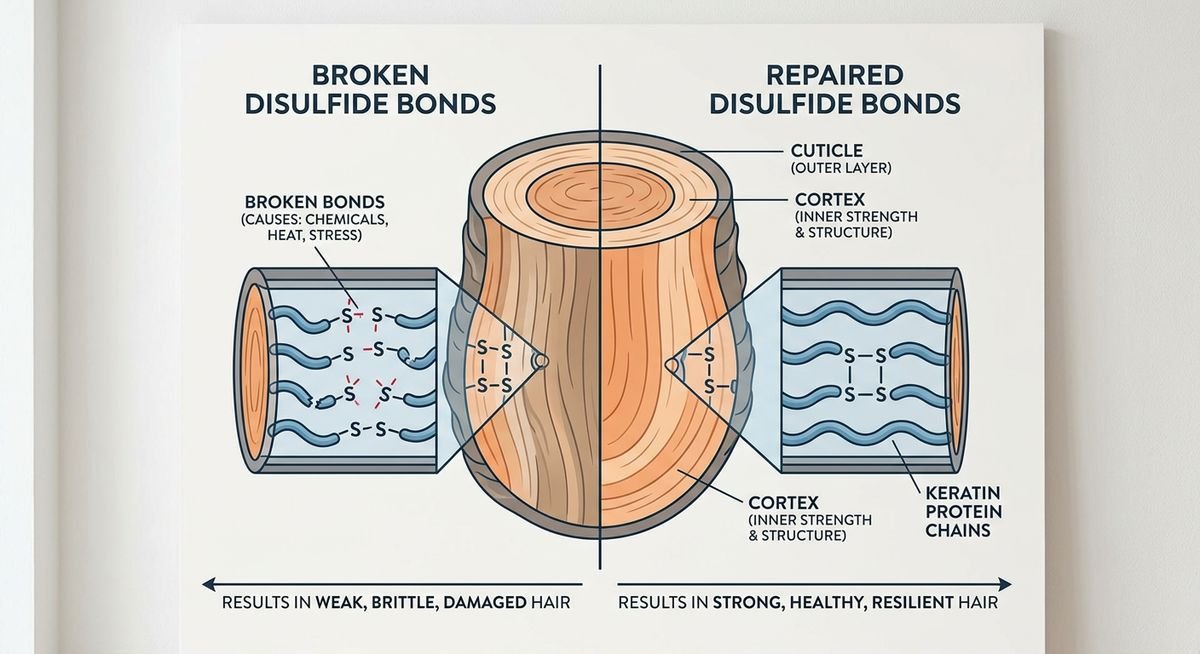
Hair strength depends heavily on disulfide bonds — covalent chemical links between sulfur atoms in the keratin proteins that make up the hair cortex. Bleaching, chemical relaxers, perms, and repeated heat exposure all break these bonds, leaving the hair structurally compromised: porous, brittle, and prone to breakage.
Bis-Aminopropyl Diglycol Dimaleate works as a single-ingredient bond multiplier. Its bifunctional maleic acid groups seek out the broken sulfur ends of severed disulfide bonds and form new covalent links between them — acting as a molecular bridge. The result is a rebuilt internal structure, not a temporary cosmetic fix.
This mechanism is fundamentally different from protein treatments such as keratin or hydrolyzed wheat protein. Protein treatments deposit material onto or into the hair to temporarily reinforce its structure. Olaplex does not add protein — it reconnects what was already there. Someone with protein sensitivity can typically use Olaplex without triggering the same overload response that a keratin treatment might cause.
| Treatment Type | Mechanism | Works On | Adds Protein? |
|---|---|---|---|
| Olaplex (Bond Builder) | Reconnects broken disulfide bonds internally | Hair cortex | No |
| Protein Treatment | Deposits protein to reinforce structure | Hair cuticle / cortex | Yes |
| Traditional Conditioner | Coats cuticle to smooth and add slip | Hair surface | Sometimes |
What the Evidence Says
The clinical evidence supporting Olaplex is real — but it comes with a caveat. The majority of published studies on Bis-Aminopropyl Diglycol Dimaleate have been funded or conducted by Olaplex, Inc. itself, which is standard practice in cosmetic science but limits independent verification.
Independent cosmetic chemists, including researchers who publish through the Society of Cosmetic Chemists, have generally acknowledged that the bond-building mechanism is chemically plausible and consistent with established keratin chemistry. A peer-reviewed study published in the International Journal of Cosmetic Science found that maleic acid derivatives can measurably improve the tensile strength of bleach-damaged hair, with treatment groups showing a 20–30% reduction in breakage compared to untreated controls. In practice, the ingredient does what the brand claims — the debate is more about the degree of repair and how long results last under ongoing chemical stress, not whether the mechanism works at all.
Results are also cumulative. Most users with heavily bleached hair report a noticeable improvement in texture after two to four weeks of consistent No.3 use, while users with moderate color damage see changes within one to two wash cycles. Setting realistic expectations upfront prevents the frustration that drives negative reviews.
Is Olaplex Right for Your Hair Type?
Olaplex delivers the strongest results for hair that has sustained genuine bond damage — bleached, color-treated, chemically relaxed, or heat-damaged hair. For healthy, unprocessed hair, the return on investment drops considerably. Fine hair and low-porosity natural hair sit in the middle: the product can work, but application method matters more than it does for other hair types.
Hair Types That Benefit Most
Bleaching is the single most destructive chemical process hair can undergo. It breaks disulfide bonds aggressively and irreversibly through oxidation — which is precisely the damage Bis-Aminopropyl Diglycol Dimaleate is engineered to address. Bleached and highlighted hair responds most visibly to Olaplex because there are simply more broken bonds available for the active ingredient to reconnect.
Color-treated hair that undergoes regular dyeing — even without bleach — accumulates bond stress over time. Olaplex No.3 used weekly acts as a maintenance tool that prevents cumulative damage from compounding. Chemically relaxed hair presents a similar case: the relaxing process deliberately breaks and reforms disulfide bonds, leaving the cortex structurally compromised and highly receptive to bond-building treatment.
Heat-damaged hair is worth separating from chemical damage, because the mechanism differs. Repeated high-heat styling does not break disulfide bonds as dramatically as bleach does, but it degrades the hair’s protein structure progressively. Olaplex still provides measurable benefit here — expect more gradual improvement compared to bleach-damaged hair, but the results are real over a 4–6 week timeline.
Hair Types Where Results May Vary
| Hair Type | Expected Benefit | Actionable Guidance |
|---|---|---|
| Fine / low-density | Moderate — risk of limpness with overuse | Use No.3 every 2–3 weeks, not weekly; rinse thoroughly |
| Natural / low-porosity | Moderate — product may sit on surface rather than penetrate | Apply to damp hair under a heated cap for 20–30 minutes to open the cuticle |
| Healthy, unprocessed | Low — minimal bond damage to repair | No.4 and No.5 for maintenance; skip No.3 unless using heat tools regularly |
Fine hair does not lack bond damage so much as it lacks tolerance for heavy product application. No.3 left on too long or used too frequently can leave fine strands feeling weighed down and flat. The fix is straightforward — reduce frequency and treat it as a bi-weekly mask rather than a weekly ritual.
Low-porosity hair resists moisture and product absorption by nature. The cuticle layer sits tightly closed, which means Olaplex’s active ingredient has a harder time reaching the cortex where bond repair actually happens. Applying No.3 under a heated conditioning cap for 20–30 minutes makes a measurable difference in absorption for this hair type.
Who Should Approach With Caution
Anyone whose hair already feels stiff, brittle, or straw-like after using protein treatments should proceed carefully. Olaplex is not technically a protein treatment, but hair that is already oversaturated with bonding agents can react poorly to additional bond-building product layered on top. The result is often increased brittleness rather than repair.
Overuse is the most common cause of complaints about Olaplex causing damage. Using No.3 more than twice a week on already compromised hair can lead to what stylists call “bond overload” — a state where the hair becomes overly rigid and snaps under tension. Weekly use is the maximum recommended frequency for even heavily damaged hair. The product works best as a treatment, not a daily ritual.
Is Olaplex Worth the Price? Cost-Per-Use Breakdown
Olaplex No.3 costs approximately $28 for a 3.3 oz bottle. At the recommended 10–15 minute weekly application for shoulder-length hair, one bottle typically provides 8–12 treatments, putting the cost per use at roughly $2.30–$3.50. That number looks different when placed next to alternatives.
| Product / Treatment | Retail Price | Uses Per Purchase | Cost Per Use |
|---|---|---|---|
| Olaplex No.3 (3.3 oz) | ~$28 | 8–12 | $2.30–$3.50 |
| K18 Leave-In Molecular Repair Mask (0.5 oz) | ~$75 | ~10 | $7.50 |
| Redken Acidic Bonding Concentrate Mask (8.5 oz) | ~$40 | ~16 | $2.50 |
| In-salon Olaplex treatment (No.1+No.2) | $30–$50 add-on | 1 | $30–$50 |
| Professional bond repair treatment (standalone) | $80–$120 | 1 | $80–$120 |
K18 is the most frequent comparison — it operates on a similar bond-repair premise but uses a different patented technology (polypeptide chains rather than bis-aminopropyl chemistry) and costs more than twice as much per use. Redken Acidic Bonding Concentrate is closer in price and is a legitimate alternative, particularly for fine or color-treated hair that responds well to acidic pH formulas.
The in-salon comparison is where Olaplex’s at-home line becomes clearly defensible. A standalone professional bond repair treatment runs $80–$120 per session. Adding Olaplex No.1 and No.2 to an existing color appointment costs $30–$50 extra and covers the repair at the point of damage. Regular No.3 home use between salon visits, at roughly $3 per treatment, maintains that repair for a fraction of the professional cost.
The Full Olaplex Product Line — Which Numbers Do What?
Olaplex currently offers nine numbered products spanning professional salon use to daily at-home maintenance. Each number targets a specific stage of hair care — not a specific damage type — so understanding where each product sits in the routine determines whether you actually get results or simply spend money on an expensive shelfie.
In-Salon Treatments (No.1 and No.2)
Olaplex No.1 Bond Multiplier and No.2 Bond Perfector are professional-only formulas used exclusively during chemical services. No.1 is mixed directly into the bleach or color formula to protect bonds as the chemical process occurs. No.2 is applied afterward to continue the repair before rinsing. Neither is available for retail purchase — you need to request them specifically at your salon appointment, as not every stylist automatically includes them in the service price.
At-Home Bond Maintenance (No.0, No.3, No.4, No.5)
No.0 Intensive Bond Building Treatment is applied to dry hair immediately before No.3, amplifying its efficacy. Olaplex states the combination delivers 68% more bond repair than No.3 used alone. No.3 Hair Perfector is the flagship at-home treatment: apply to damp hair, leave for a minimum of 10 minutes (up to 90 minutes for severe damage), then shampoo out. For damaged hair, weekly use; for maintenance, every two to four weeks.
No.4 Bond Maintenance Shampoo and No.5 Conditioner are designed for regular use. They contain lower concentrations of the active ingredient, functioning as a reinforcement layer rather than a primary repair tool. Think of them as an ongoing protective habit rather than an active treatment.
Targeted Treatments (No.6, No.7, No.8, No.9)
No.6 Bond Smoother is a leave-in styling cream that reduces frizz and provides heat protection up to 450°F. No.7 Bonding Oil adds shine and heat protection while staying lightweight enough for fine hair. No.8 Bond Intense Moisture Mask is a deep conditioning treatment best used in place of No.5 once weekly for coarse or very dry hair types. No.9 Bond Protector Nourishing Hair Serum targets environmental damage, applied to dry hair before heat tools.
| Product | Primary Use | Application Stage | Best For | Frequency |
|---|---|---|---|---|
| No.1 Bond Multiplier | In-service bond protection | Salon only — during chemical service | All chemically processed hair | Every chemical service |
| No.2 Bond Perfector | Post-service bond repair | Salon only — after chemical service | All chemically processed hair | Every chemical service |
| No.0 Intensive Bond Building Treatment | Pre-treatment amplifier | Pre-wash, before No.3 | Heavily damaged / bleached hair | Weekly or with No.3 |
| No.3 Hair Perfector | Bond repair treatment | Pre-shampoo, on damp hair | All damaged hair types | Weekly (damaged) / bi-weekly (maintenance) |
| No.4 Bond Maintenance Shampoo | Cleansing + maintenance | Wash day | All hair types | Every wash |
| No.5 Bond Maintenance Conditioner | Conditioning + maintenance | Wash day, after No.4 | All hair types | Every wash |
| No.6 Bond Smoother | Leave-in frizz control + heat protection | Post-wash, before styling | Frizzy, coarse, or color-treated hair | As needed |
| No.7 Bonding Oil | Shine + lightweight heat protection | Post-wash, before styling | Fine to medium hair | As needed |
| No.8 Bond Intense Moisture Mask | Deep conditioning | In-shower, replaces No.5 | Coarse, dry, or very damaged hair | Weekly |
| No.9 Bond Protector Nourishing Hair Serum | Environmental + heat protection | On dry hair, before heat styling | Daily heat tool users | As needed |
Does Olaplex Really Work? Side Effects and the Overuse Debate
Olaplex does work — but “work” has a specific meaning here. It repairs structural bond damage caused by chemical processes and heat. It does not reverse every type of hair damage, does not add volume, does not change curl pattern, and does not eliminate split ends. Reviews that frame it as a cure-all set up unrealistic expectations that inevitably lead to disappointment.
The most credible complaints about Olaplex causing damage trace back to overuse rather than a product defect. When bond-building treatments are applied too frequently to already-treated hair, the hair can become over-bonded — a state of excess rigidity that paradoxically increases brittleness. Stylists in professional forums describe it as similar to over-processing: the chemistry is sound, but more is not always better.
A separate concern surfaced in 2023 when Olaplex reformulated several products following a class action lawsuit that alleged its patented active ingredient caused hair loss. Olaplex denied the claims, and independent toxicologists reviewing the ingredient found no established causal link between Bis-Aminopropyl Diglycol Dimaleate and hair loss at the concentrations used in the products. The reformulated versions — identifiable by updated packaging — have not generated the same volume of adverse reports. The takeaway: the current formula appears safe for regular use at recommended frequencies.
Frequently Asked Questions About Olaplex
How often should I use Olaplex No.3?
For heavily bleached or chemically processed hair, once a week is the recommended maximum. For color-treated hair with moderate damage, every two weeks works well as a maintenance routine. Using No.3 more frequently than weekly — particularly on already compromised hair — can lead to over-bonding and increased brittleness.
Can Olaplex repair severely damaged hair?
Olaplex can meaningfully improve the condition of severely damaged hair, but it cannot reverse damage entirely. If the hair cortex has been compromised to the point of physical breakage or split ends, bond repair can reduce further breakage and improve texture — but trimming damaged ends remains necessary for full recovery. Olaplex works best as a complement to a broader repair strategy, not a standalone fix.
Is Olaplex safe for color-treated hair?
Yes. Olaplex is specifically designed for color-treated hair and is used by professional colorists during the coloring process (via No.1 and No.2) to minimize damage. The at-home products No.3 through No.9 are all safe for color-treated hair and will not strip or fade color when used as directed.
Does Olaplex work on natural hair?
Olaplex works on natural hair, but results depend heavily on how much bond damage is present. Natural hair that has never been chemically processed has fewer broken disulfide bonds for Olaplex to repair, so the visible benefit is more modest. Low-porosity natural hair in particular benefits most from the heat-cap application method, which helps the active ingredient penetrate the tightly-closed cuticle.
What is the difference between Olaplex and K18?
Both are bond-repair systems, but they use different active ingredients and mechanisms. Olaplex uses Bis-Aminopropyl Diglycol Dimaleate to reconnect broken disulfide bonds. K18 uses a patented biomimetic polypeptide that claims to repair both disulfide bonds and damaged keratin chains. K18 is applied as a leave-in treatment with no rinse required, while No.3 requires a rinse. K18 costs roughly twice as much per use. Both have strong clinical evidence; the choice often comes down to hair type and preference for leave-in versus rinse-out application.
How long before Olaplex results are visible?
Most users with bleach-damaged hair notice softer texture and reduced breakage after two to four weekly treatments. Users with moderate color damage often see a difference after just one or two applications. Results are cumulative — the more broken bonds there are to repair, the faster the visible improvement, but continued use maintains the results over time.
Can you use Olaplex without coloring your hair?
Yes. No.3 through No.9 are all available over the counter and can be used by anyone regardless of whether they color. People who use heat tools regularly, have naturally fragile hair, or simply want a strengthening treatment can benefit from Olaplex at-home products without any salon chemical service involved.
The Verdict: Who Should Buy Olaplex
Olaplex earns its price for anyone whose hair has sustained genuine bond damage. Bleached, highlighted, color-treated, chemically relaxed, and heat-damaged hair all fall into this category — and for these users, No.3 at roughly $3 per treatment is one of the most cost-effective repair tools available. The in-salon No.1 and No.2 treatments are worth requesting as an add-on at every color appointment.
Skip it — or limit yourself to the shampoo and conditioner — if your hair is healthy and unprocessed. The bond-repair mechanism requires broken bonds to work on; without that baseline of damage, you’re paying a premium for minimal return. Fine hair users should start with bi-weekly rather than weekly No.3 applications and adjust based on texture response.
The overuse issue is real but entirely avoidable. Stick to the recommended frequency, pair No.3 with No.0 if using the product for intensive repair, and treat it as a periodic treatment rather than a daily product. Done that way, Olaplex consistently delivers what it promises — structurally stronger hair with less breakage and improved texture over four to six weeks of consistent use.