
Selling a home in the United States comes with a legal obligation most first-time sellers do not see coming: you have to tell the buyer what is wrong with the property, in writing, before the deal closes, says Shannon Property Management specialists. Understanding the legal requirements for property disclosure is not optional, and it is not a courtesy. It is a requirement enforced by state statutes, federal regulations, and decades of court rulings that have steadily eroded the old “buyer beware” doctrine.
Every state now imposes some form of mandatory seller disclosure, though what must be disclosed, when, and on what form varies considerably from one jurisdiction to the next. Getting it wrong can unravel a sale months after closing, trigger six-figure judgments, and in some states, expose sellers to treble damages.
What Property Disclosure Laws Require From Sellers
Property disclosure laws require home sellers to provide buyers with a written statement listing all known material defects affecting the property’s value or safety before the purchase agreement becomes binding. A material defect is any condition that would influence a reasonable buyer’s decision to purchase or the price they would pay, had they known about it before signing.
The legal foundation rests on the principle that sellers possess asymmetric information about their own property, a concept well established in U.S. real estate law. They have lived in it, maintained it, and know where the basement floods or the roof leaks. Buyers, despite conducting inspections, cannot reasonably discover every hidden flaw during a standard due diligence period. Disclosure laws close this information gap.
Most states provide a standardized disclosure form that sellers must complete. These forms typically run four to six pages and cover structural elements, environmental hazards, mechanical systems, and legal encumbrances. California’s Transfer Disclosure Statement, for example, spans multiple pages and asks about everything from earthquake damage to neighborhood noise issues. In contrast, some states like Alabama still follow a more limited “caveat emptor” approach for certain defect categories, though even there, active concealment remains illegal.
“The modern trend in real estate law has been to impose an affirmative duty on sellers to disclose known, latent, material defects. It is no longer enough to simply refrain from lying.”
— American Bar Association, Real Property Section
Federal vs. State Disclosure Requirements: Where the Rules Come From
Property disclosure obligations in the United States operate on two overlapping legal tiers. Federal law mandates specific disclosures regardless of state boundaries, while state law fills in the broader obligation to reveal property defects.
At the federal level, the most prominent requirement is the Residential Lead-Based Paint Hazard Reduction Act of 1992. Any home built before 1978 triggers a mandatory lead paint disclosure, including an EPA-approved pamphlet, a 10-day inspection window for the buyer, and signed acknowledgment forms. The penalty for non-compliance can reach $19,507 per violation. Separately, coastal properties may trigger flood zone disclosure requirements under the National Flood Insurance Program, and some homes near military bases require disclosure of noise and accident potential zones.
State laws, by contrast, govern the bulk of what sellers must reveal. The table below illustrates how disclosure standards diverge across a few representative states.
| State | Disclosure Standard | Form Required | Notable Mandatory Items |
|---|---|---|---|
| California | Strict: all known material facts | Transfer Disclosure Statement (TDS) | Deaths on property within 3 years, neighborhood noise, Mello-Roos assessments |
| Texas | Broad: known material defects | Seller’s Disclosure Notice | Previous structural repairs, termite history, flood zone status |
| New York | Moderate: can opt for $500 credit instead | Property Condition Disclosure Statement | Statutory exemptions allow credit in lieu of full disclosure |
| Alabama | Limited: caveat emptor still applies broadly | No standardized state form | Active fraud or concealment still actionable; some local forms exist |
| Florida | Broad: known facts materially affecting value | Seller’s Property Disclosure | Must disclose sinkhole activity, coastal erosion, HOA restrictions |
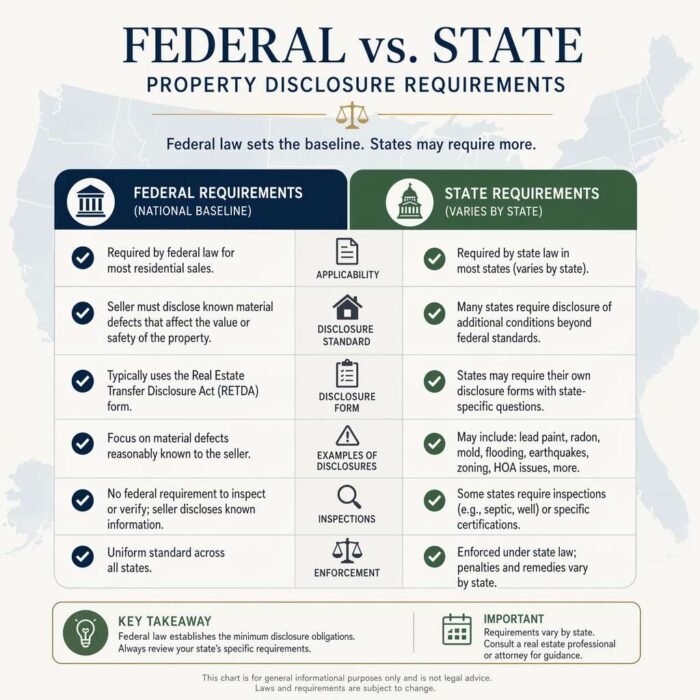
The critical takeaway: the state where the property sits determines the bulk of the seller’s legal obligation, not the state where the buyer or seller currently lives. A seller moving from Alabama to sell a California home must comply with California’s stricter standard. Cross-state transactions add complexity that a local real estate attorney is best positioned to navigate.
What Defects Sellers Must Legally Disclose
While specific lists vary by state, most disclosure statutes converge on four core categories of defects that sellers must reveal. These are the conditions courts most frequently cite in non-disclosure lawsuits.
Structural and mechanical defects. Foundation cracks, roof leaks, HVAC system failures, plumbing issues, electrical hazards, and water intrusion all fall into this bucket. Anything that compromises the property’s physical integrity is almost certainly material. A 2023 survey of real estate litigation by the National Association of Realtors found that water damage and foundation problems were the two most common subjects of post-sale disclosure disputes.
Environmental hazards. Lead paint in pre-1978 homes is the federal mandatory item, but states add their own layers. Radon gas, asbestos insulation, underground storage tanks, methamphetamine contamination, and proximity to Superfund sites all require disclosure in various states. California specifically requires disclosure if the property is within one mile of a known earthquake fault zone.
Legal and title issues. Boundary disputes, easements, HOA liens, pending assessments, zoning violations, and any ongoing litigation affecting the property all qualify as material. A pending lawsuit over a property line, even if the seller believes they will win, must be disclosed because it clouds the title and could affect the buyer’s use of the land.
Deaths and stigmatized properties. This category gets complicated fast. Most states require disclosure of deaths on the property within a specific timeframe. California mandates disclosure of any death within three years. Other states exempt deaths from natural causes or HIV/AIDS. A handful of states specifically exempt “psychological stigmas” such as a property being the site of a murder or reportedly haunted, provided the buyer does not ask directly.
When Disclosures Must Happen in a Transaction Timeline
Timing matters as much as content. Most states require the seller to deliver the completed disclosure form to the buyer before the purchase agreement becomes binding, or within a specified number of days after acceptance. Getting the sequence wrong can give the buyer a unilateral right to cancel.
The typical timeline unfolds in three phases. First, the seller completes and delivers the disclosure statement, usually within three to five days of accepting an offer. Second, the buyer receives a statutory review period, commonly three to five days in most states but up to 10 days in some, during which they can back out without penalty based on what the disclosure reveals. Third, if new defects are discovered or existing conditions worsen between the initial disclosure and closing, the seller must update the disclosure. A roof that held up during listing but leaked after a storm two weeks before closing creates a new obligation to inform the buyer.
This timeline interacts with the inspection contingency. A buyer who waives the inspection contingency has not waived the right to receive disclosures. Sellers who assume otherwise, rushing to close without updating disclosures after discovering a new problem, routinely lose in court.
What Happens If a Seller Fails to Disclose
The consequences of failing to disclose a known material defect range from financially painful to legally catastrophic. Courts treat non-disclosure as a form of fraud, and the remedies available to buyers reflect that classification.
Buyers who discover undisclosed defects after closing can sue for actual damages, which typically cover the cost of repairs plus any diminution in property value caused by the defect. In many states, courts may also award rescission, meaning the entire transaction is unwound, the seller takes the property back, and both parties return to their pre-sale positions, minus the seller’s legal fees. The most aggressive remedy, treble damages plus attorney fees, is available under consumer protection and fraud statutes in states like Massachusetts, where willful non-disclosure can triple the buyer’s recovery.
Real estate agents can also face liability. If an agent knew or should have known about a defect and failed to ensure disclosure, both the agent and their brokerage may be named as co-defendants. A real estate lawyer who handles property transactions will typically advise both sellers and agents to err on the side of over-disclosure, because the cost of defending a non-disclosure lawsuit far exceeds the cost of disclosing a minor defect that might not even affect the final sale price.
Practical Steps for Buyers Reviewing Disclosure Documents
Receiving a disclosure statement is not a substitute for independent due diligence. Buyers should treat disclosures as a starting point for investigation, not a warranty that everything is fine.
Read every line of the disclosure form carefully before the statutory review period expires. If the seller checked “unknown” for a major system like the roof or foundation, ask why. A seller who claims not to know the age of their own roof after living in the home for eight years is either being evasive or negligent, and either scenario warrants a closer look during the inspection. Compare the disclosure against what the seller’s listing agent said in marketing materials and what you observed during showings. Inconsistencies between a listing that touts “newer HVAC” and a disclosure that marks “unknown” for the system’s condition are red flags worth raising with your agent or a real estate attorney.
Keep the disclosure form after closing. It is a legal document that can serve as evidence if defects surface later and it turns out the seller knew about them but failed to list them. A buyer who throws the disclosure in a drawer and forgets about it loses the single most valuable piece of evidence in a subsequent non-disclosure claim.
Frequently Asked Questions About Property Disclosure
What is a seller’s property disclosure?
A seller’s property disclosure is a legally mandated written statement in which the homeowner lists all known material defects affecting the property’s value, safety, or desirability, delivered to the buyer before the purchase contract becomes final.
Are there federal laws that require property disclosure?
Yes. The federal Residential Lead-Based Paint Hazard Reduction Act requires sellers of homes built before 1978 to disclose known lead paint hazards, provide an EPA pamphlet, and give buyers a 10-day inspection window. Coastal flood zone regulations also impose federal disclosure obligations for certain properties.
Can a seller skip disclosure by selling a home “as-is”?
No. An “as-is” sale typically means the seller will not make repairs, not that they can withhold known defect information. In most states, the duty to disclose survives an as-is clause. The buyer accepts the property in its current condition but retains the right to know what that condition actually is.
Can a real estate agent be held liable for non-disclosure?
Yes. Agents who know about undisclosed material defects and fail to ensure they appear on the disclosure form can face liability alongside the seller. Most standard listing agreements require agents to disclose known adverse material facts about the property, regardless of whether the seller wants them revealed.
Does a seller need to update the disclosure before closing?
Yes. If a material defect develops or is discovered between the initial disclosure and the closing date, the seller must update the disclosure and give the buyer a new review period. Failing to do so constitutes fraud by omission in every jurisdiction that has addressed the question.
The Bottom Line
Property disclosure is not a paperwork formality. It is the legal mechanism that prevents sellers from profiting from hidden defects and gives buyers the information they need to make an informed decision. The patchwork of federal and state requirements means the specific rules depend heavily on where the property sits, but the underlying principle is consistent across all fifty states: tell the truth, in writing, before the ink dries on the contract. When in doubt, disclose. The cost of over-disclosing is a marginally tougher negotiation. The cost of under-disclosing can be a lawsuit that unwinds the entire deal.