
It is not simply a matter of pouring grass into the soil and waiting for it to rain. It involves a combination of clever soil science, a considered choice of products, and a couple of tricks of the trade that landscape designers use to create an illusion of maturity in the garden as it takes form. This is your guide to greening a business location within the shortest time possible.
1. Soil Preparation: Fix Compaction and Improve Soil Health
Moving on to the green rush, it would be most tempting to avoid this step, and that is the most significant error of all. Bad soil is a characteristic of construction sites. Massive excavators and cranes will have made the ground so solid that it is almost concrete. When you just plant directly into that, your expensive new plants will struggle and eventually die as their roots are not able to breathe or penetrate the earth.
In order to achieve quick results, one is required to de-compact the site. This normally entails plowing or tilling the soil to loosen that hardpan layer. After opening up the ground, it is necessary to add organic matter, i.e., compost, farm manure (aged), or special soil conditioners.
Imagine a house; you would not create the roof before the foundation is poured. The same logic applies here. When you take a week to prepare the soil, your plants will grow twice as fast during their first season. You are pretty much building a five-star hotel for root systems, and the vegetation will pay you back with fast and healthy upper growth.
2. Sod vs. Hydroseeding: Choosing the Fastest Lawns
Nothing can be better than sod (also called turf) when speed is the only parameter that counts. Sod is the quick fix of the landscaping world. You can begin the day with bare earth and have a green, trim lawn at the end of it that looks as though it had been maintained for years. In high-traffic zones, such as the main entrance, the roadside, or courtyards where clients will be walking right away, there is no doubt that sod is king.
Sod is, however, labor-intensive and expensive. If your business premises covers a couple of acres, it may cost a fortune to sod the entire area. This is where contemporary revegetation solutions come into play.
In larger spots, or where the main building entrance is distant, hydroseeding is the best friend of speed. It is carried out by spraying a slurry of seed, mulch, fertilizer, and binding agents onto the soil. It is not instant (like sod), but it is much quicker than old-fashioned hand-seeding. The mulch is moist and warm, functioning as a mini-greenhouse for the seed. Given the right conditions, it can grow a green fuzz in as little as 5 to 7 days and a lawn ready to mow in a few weeks. It is the ideal compromise of price and speed.
3. Planting Mature Trees for Instant Landscape Impact
Unless you want your business location to look like a nursery experiment on day one, you cannot trust in tubestock or miniature seedling pots. They are inexpensive, but they take years to look like something substantial. You must invest in advanced stock to green up a site as quickly as possible.
This involves purchasing 10-15 foot trees and 5-gallon potted or bigger shrubs. Yes, it is a more expensive outlay, but you are purchasing time. The mature tree offers immediate shade, vertical interest to the building, and a feeling of permanence.
Target your budget on “hero trees” at strategic points of entry, corners inside the building, and outside seating. You can make up the background with smaller, less expensive plants, but those big anchor plants will be doing the heavy lifting in terms of appearance. Further, select those species that grow rapidly. Native pioneer species are usually the best due to the fact that they have a genetic code to grow rapidly in disturbed soil, which is precisely what a construction site is.
4. Commercial Landscaping Hacks: Container Gardens and Hardscaping
There are times when you just cannot plant in the ground yet—perhaps the soil is undergoing remediation, or it is not the appropriate season to plant. This is where container gardening comes to the rescue. Massive architecturally designed pots containing full-grown plants can be installed immediately at entrances and walkways.
This technique is popular with visual merchandisers since it is modular. A concrete plaza can be made green in an afternoon by placing a couple of half-ton planters with olive trees or bamboo using a crane. It provides instant color, elevation, and texture without putting a single shovel in the ground.
Equally, you cannot undervalue the ability of hardscaping to dress up a site. The unsung hero of commercial landscaping is fresh mulch. A multitude of sins is buried beneath a thick layer of fine black or red mulch. It conceals drip irrigation systems, suppresses weeds, and gives a clean and crisp contrast to the green of your new plants. It gives the site the appearance of being dressed up and maintained even when the plants may not have filled out yet.
5. Automated Irrigation Systems for Rapid Plant Growth
You may have the finest soil with the most costly plants, but with no water, it all comes to a halt. Within a business context, you cannot count on a maintenance man carrying a hose. It is ineffective and unpredictable.
In order to have quick planting, a fully automated irrigation system should be installed before the plants go in. To grow rapidly, plants require regular moisture, not a flood-and-drought cycle. Drip irrigation is most suitable in garden beds since the water reaches the roots directly, lessening evaporation and weed growth.
Smart irrigation controllers can even be adjusted according to local weather conditions so that you do not risk drowning your new investment during a rainy week or scalding it during a heatwave. It is worth remembering that water is fuel for plant growth. In case you are in a hurry, fill up the tank.
6. Post-Construction Landscape Maintenance Essentials
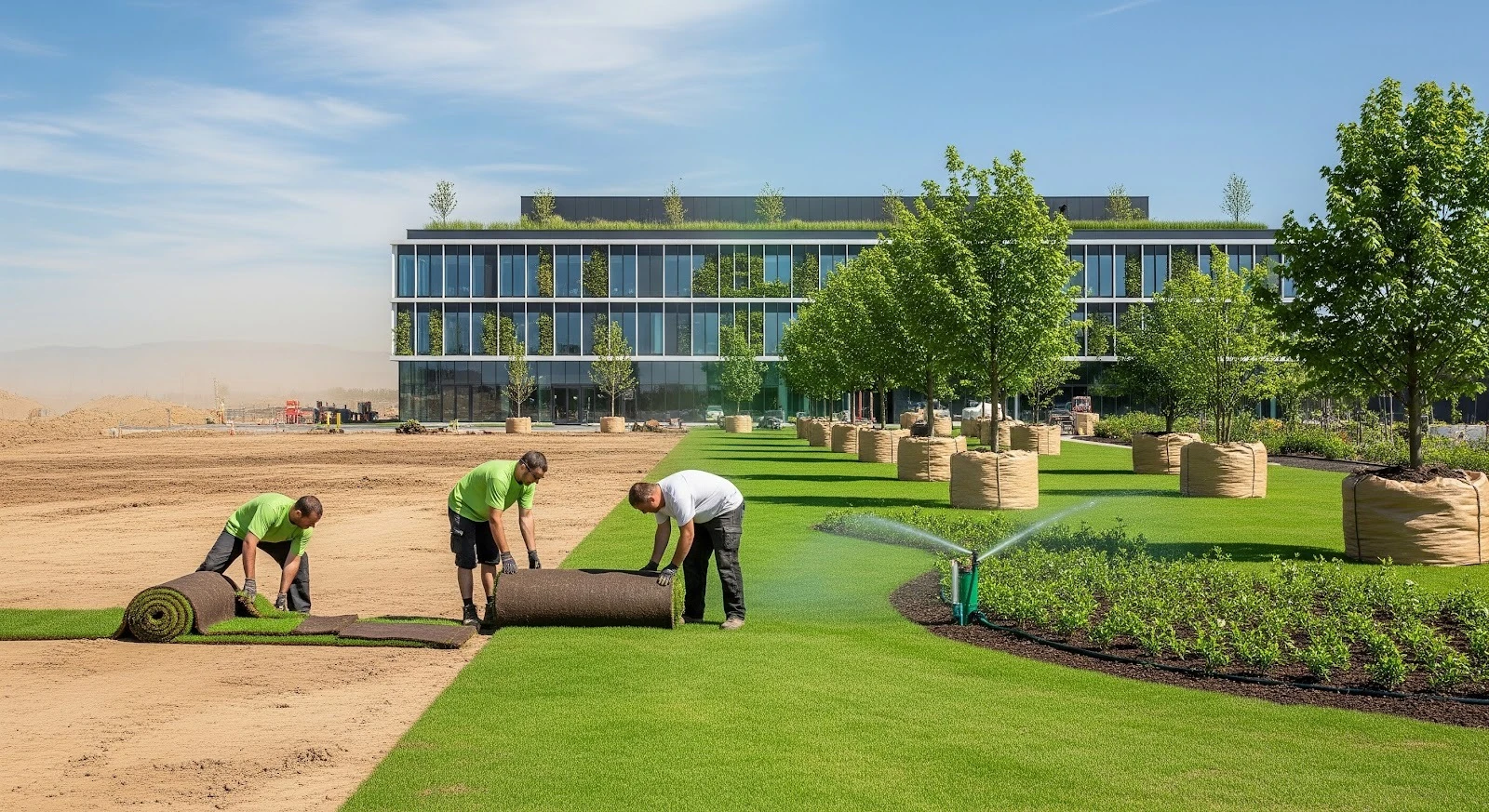
The clock begins when the green is in the ground. The first 12 weeks are critical. This is the establishment stage, where the plants are most susceptible to shock. Even a month of neglect may turn your beautiful new landscape into a cemetery of brown twigs.
At this point, professional assistance cannot be compromised. A team is required to check soil moisture and pests (which prefer stressed, new plants) and remove anything that fails to withstand transplant shock. It is usually worth searching for a “gardening company near me” to find a team specializing in post-construction care. They will have the specific fertilizers and knowledge to drive the initial growth spurt and keep the site looking clean during that initial period.
Conclusion
The rapid conversion of a business location to green is a balance between nature and money. It is possible to cheat time using sod and mature trees, and you may hasten the growth using good soil preparation and irrigation. The secret here, however, is to consider the landscape as a living feature, not only a decoration.
You can turn a dusty construction site into a colorful commercial center within weeks by putting money into the boring stuff, such as soil preparation and irrigation infrastructure, and then augmenting that with high-impact strategies, such as advanced trees and hydroseeding. The result? A property that is welcoming, oriented, and business-friendly as soon as the initial tenant enters the building.