

Designing a custom timber frame home should feel thrilling—not stressful. Yet many projects stumble over the same seven planning mistakes, from runaway square footage to lighting afterthoughts. In the next few minutes, we’ll show you how to steer clear of each pitfall so you can create a house that fits your life, your land, and your budget.
Mistake 1: Letting square footage balloon past what you’ll actually use
Every extra 100 sq ft tacks on roughly $10,000–$13,000 to a basic timber-frame shell, according to Habitat Post & Beam (2025 pricing). Push the plan just 200 sq ft and you are $20,000–$26,000 deeper before finishes or mechanicals enter the picture. According to one timber frame cost overview from Hamill Creek Timber Homes, typical timber frame kits and packages run about $60–$90 per square foot, with the biggest cost drivers including site location, timber species, frame complexity, and add-ons like decks and garages. Hamill Creek’s seven-step approach to custom timber frame homes spells out exactly where those decisions add or trim dollars, tracing costs from early 3-D modeling through off-site pre-cutting and the final on-site raising. Seen together, those numbers show how quickly a few bonus rooms and outdoor structures can compound the budget, which is why right-sizing the plan matters more than chasing raw square footage.
How to keep the footprint honest
- Define activities first. List what the home must support—sleeping, working, fitness—then map only the rooms that serve those tasks.
- Request cost checkpoints at 100-sq-ft intervals. Ask your designer to show price deltas so you see the real cost of “just a little bigger.”
- Invest in built-ins over raw volume. A well-crafted 2,200-sq-ft frame often lives larger than a 3,000-sq-ft one with wasted halls and corners.
Mistake 2: Ignoring how the house meets the land
Place your largest windows within 30 degrees of true south and you capture roughly 90 percent of the sun’s passive-heat potential, according to the U.S. Department of Energy. Angle those panes east or west and up to 76 percent of that light becomes unwanted summer heat.
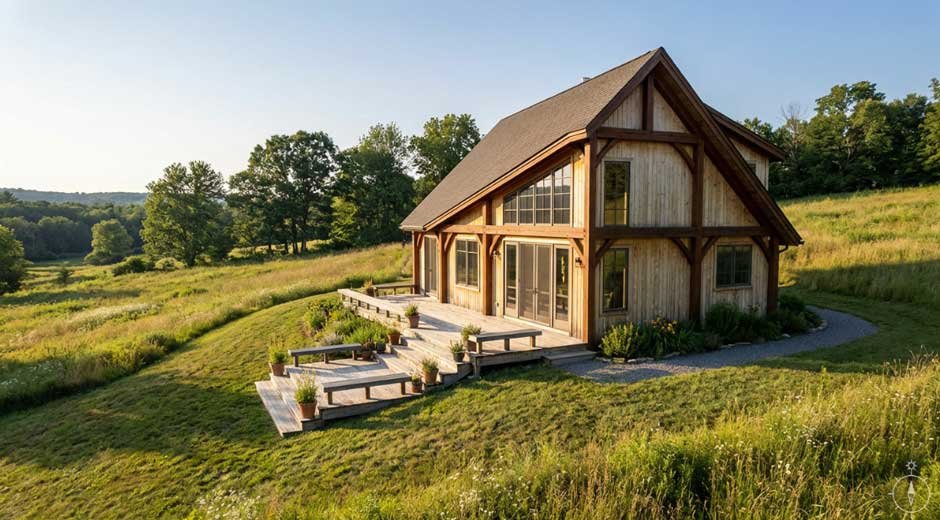
Skip that siting exercise and great rooms glare while bedrooms sit in chill. Walk the lot with your designer at morning, noon, and dusk; trace view corridors; let decks or low rooflines step with the grade. A timber frame that respects its setting feels as if it grew there, not as if it arrived on a flatbed.
Mistake 3: Overcomplicating the roof and frame
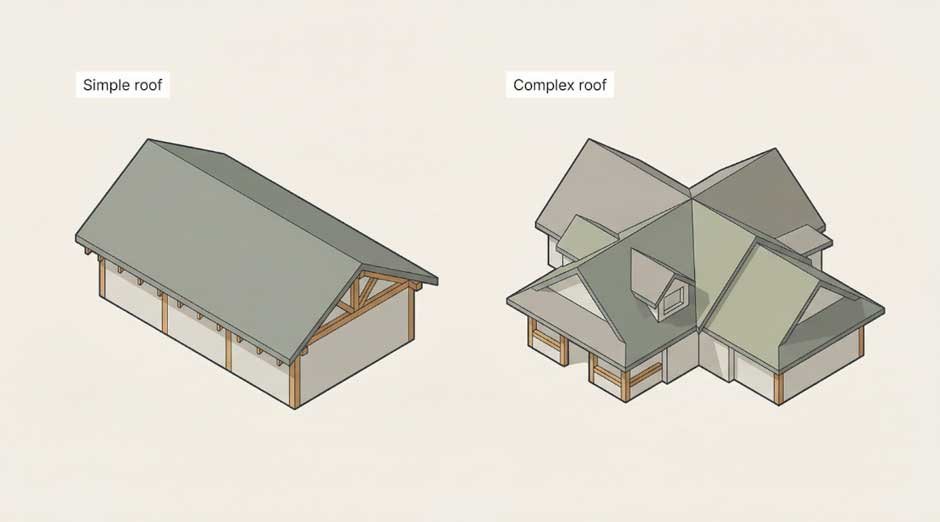
Cutting valleys, hips, and mixed pitches can raise material waste by about 15 percent and labor by 30–50 percent compared with a simple gable, report analysts at Green Metal Roofing and New England Metal Roof (greenmetal.ca, newenglandmetalroof.com). In timber framing those extra hours hit twice: once in the shop and again during the raising.
Keep the structure clear. Highlight one or two signature trusses, let the roof read as a single silhouette, and reserve funds for fine joinery where people spend time. You will still have plenty to admire, and your budget will dodge weeks of added carpentry.
Mistake 4: Treating interior planning as an afterthought
Houzz’s 2021 U.S. renovation study shows that 33 percent of homeowners rank “insufficient storage” as the top bathroom pain point, and the same gap haunts mudrooms and pantries that never made the first floor-plan draft (houzz.com). Retrofitting those spaces is costly: HomeAdvisor’s 2025 guide puts a modest mudroom addition at about $100–$300 per sq ft, or roughly $12,000 on average (homeadvisor.com).
Before you freeze the design, sketch a “normal day” on paper. Where do boots land? How far is the fridge from the garage door? Will laundry baskets cut across the kitchen work triangle? Solving these questions early lets you weave storage and clear pathways into the frame, saving both dollars and frustration long after the crew leaves.
Mistake 5: Underestimating lighting and electrical needs
Miss the lighting plan now and each forgotten junction box can add about $180 after drywall, while electricians bill $50–$100 per hour for the rework (homeadvisor.com). Layered light levels are the real fix. The Illuminating Engineering Society advises 10–20 foot-candles in living zones but 70–80 foot-candles on food-prep counters (beeslighting.com, akarui.org), a gap no single chandelier can cover.
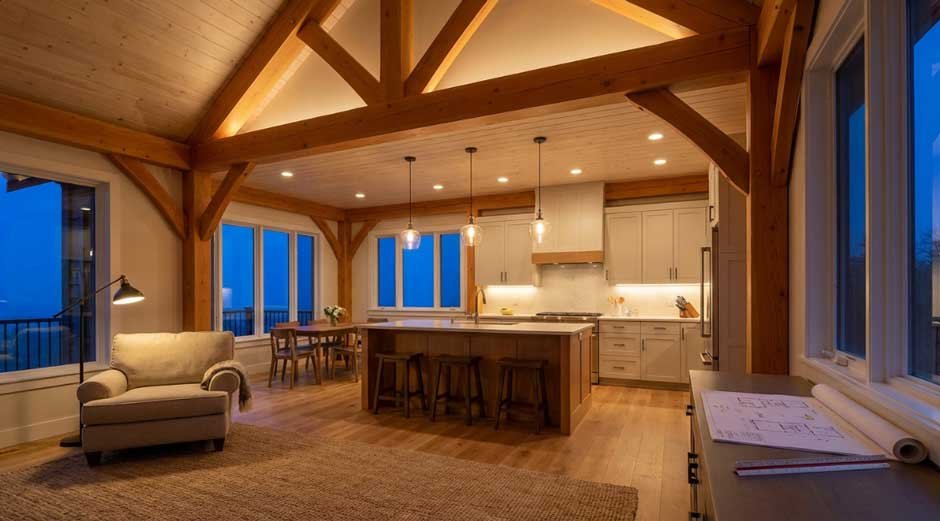
Create the lighting map while drawings lie flat. Trace beam lines, note ceiling heights, and mark where ambient, task, and accent fixtures will land. Run low-voltage channels to uplight trusses, and group switches so you can dim the great room without darkening the kitchen. A well-wired frame shows off its own joinery and saves you from chasing wires through finished wood.
Mistake 6: Forgetting about acoustics
Skip the sound study and you may pay $10–$30 per sq ft later for retrofit panels, rugs, or mass-loaded vinyl, according to HomeAdvisor’s 2025 guide. The root problem is measurable: in a timber great room, reverberation time easily climbs past the 0.6–0.8 second range acousticians recommend (wbdg.org). Heavy carpet on concrete absorbs about five times more speech-band energy than bare wood flooring, with absorption coefficients of 0.37 versus 0.07 at 1 kHz.
Plan for quiet from day one. Blend area rugs, upholstered seating, and fabric-wrapped panels into big volumes, and break up long walls with bookshelves or half-height partitions. Even a timber frame benefits from a little hush.
Mistake 7: Not building in flexibility
Converting a spare bedroom into a home office after walls are up runs about $100 per sq ft, or roughly $15,000, based on HomeAdvisor’s 2025 data (homeadvisor.com). That retrofit stings when a little foresight could have cost pennies during framing. The National Association of Realtors reports that 40 percent of 2025 buyers would trade overall square footage for rooms that can shift among office, guest, or hobby roles—up from 21 percent in 2022 (nar.realtor).
Design adaptability now. Pull wiring for future desks or treadmills, specify non-load-bearing partitions that can slide or disappear, and position windows so a kids’ play loft can evolve into a quiet studio. A timber frame’s wide spans simplify these moves, letting the home grow with you instead of fighting your next chapter.
Conclusion
A timber frame’s wide spans simplify future adaptations, letting your home evolve with you instead of resisting your next chapter. By steering clear of these seven mistakes from the outset, you’ll craft a resilient, efficient, and welcoming space that truly fits your life, your land, and your budget.